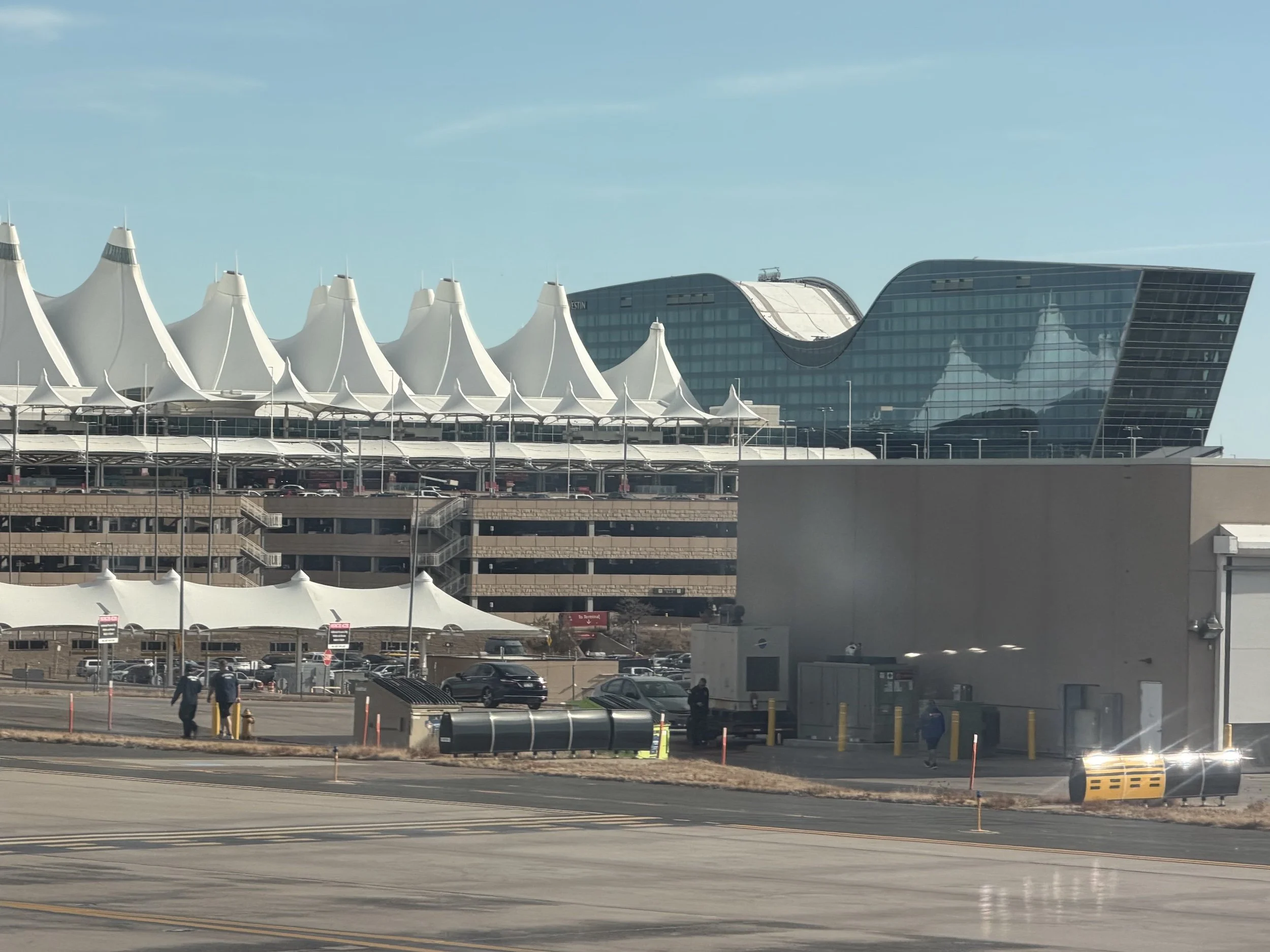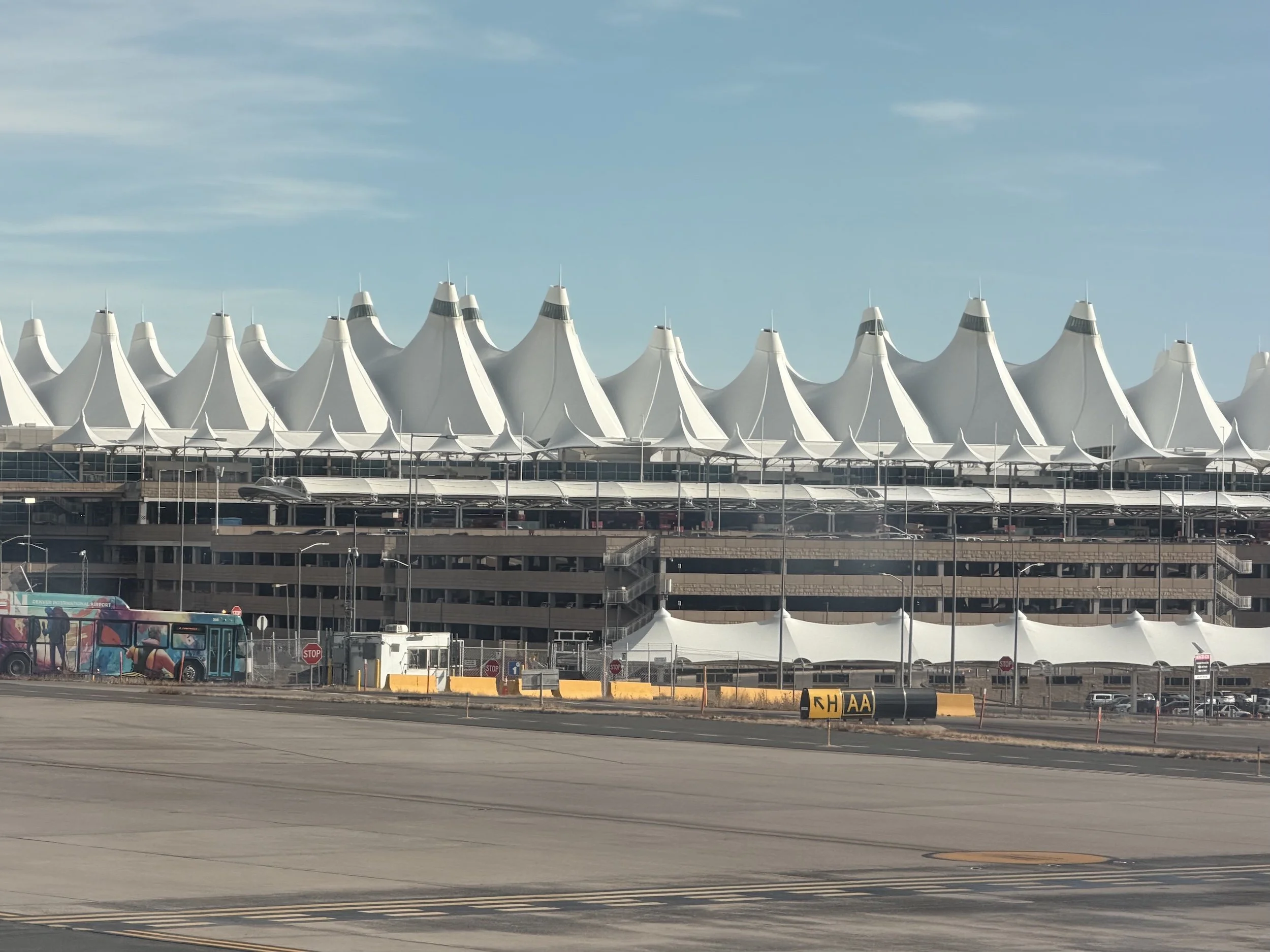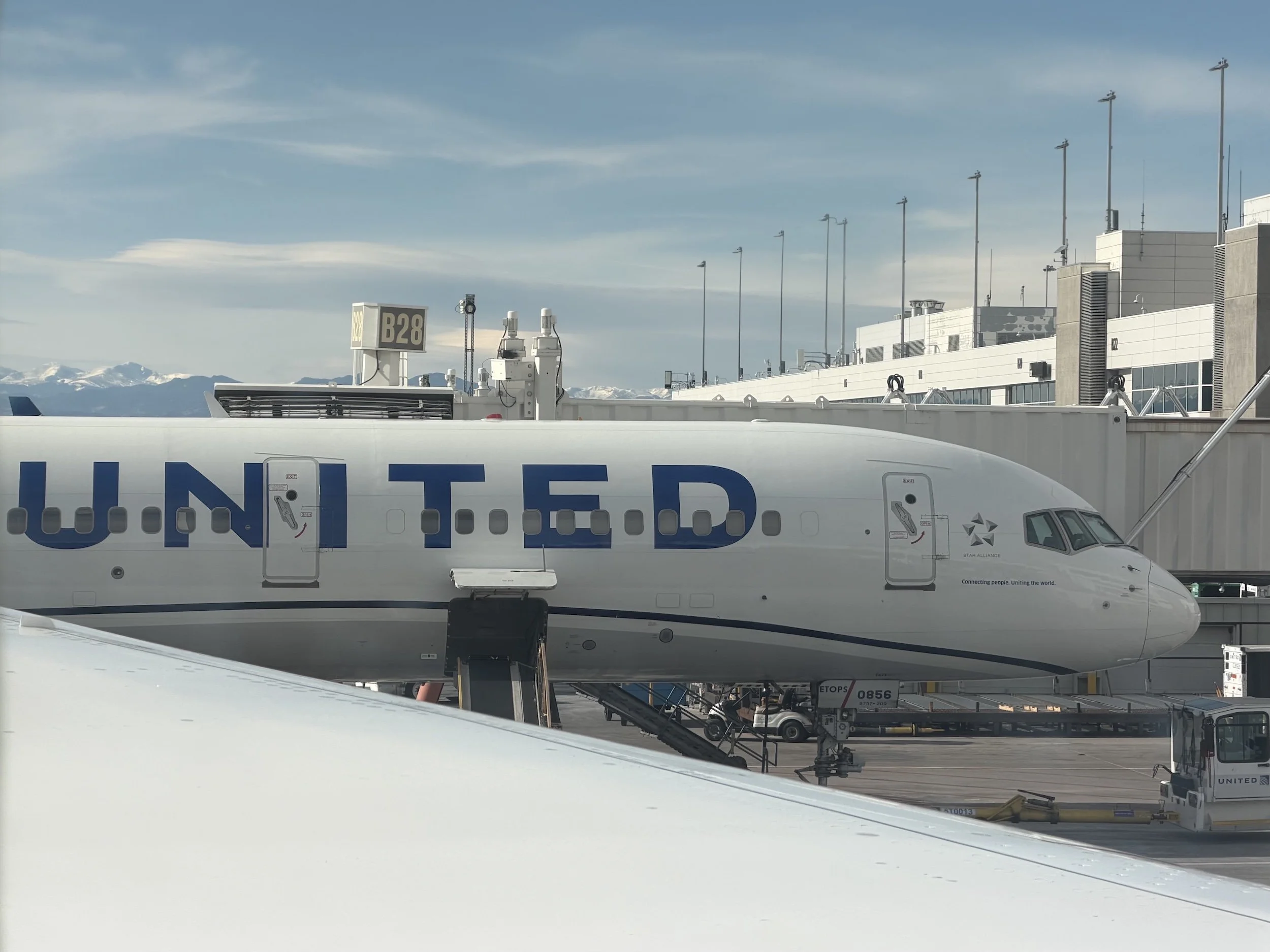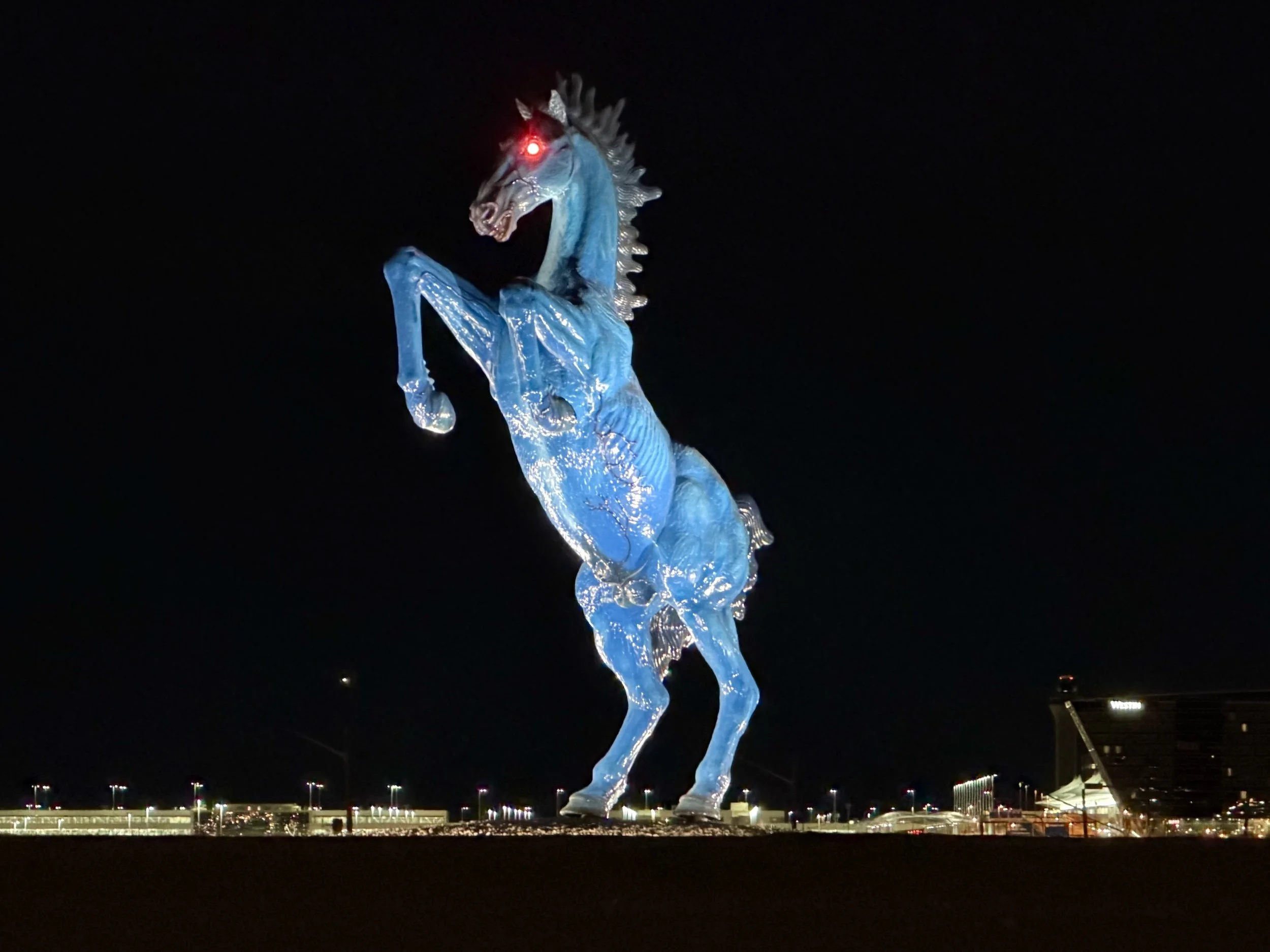
A red-eyed horse sculpture that killed its creator greets motorists as they approach Denver International Airport, where public art and conspiracy theories converge in the shadow of the Rocky Mountains. The 32-foot blue mustang sculpture—nicknamed “Blucifer”—looks like one of the four horses of the apocalypse, rearing up on its hind legs outside America’s biggest airport, which is twice the size of Manhattan. It’s just the tip of the iceberg when it comes to provocative art and civil engineering at this airport, a busy hub steeped in the kind of folklore that galvanizes gabby Uber drivers at 2 a.m.
Denver’s Own ‘Spook Central’
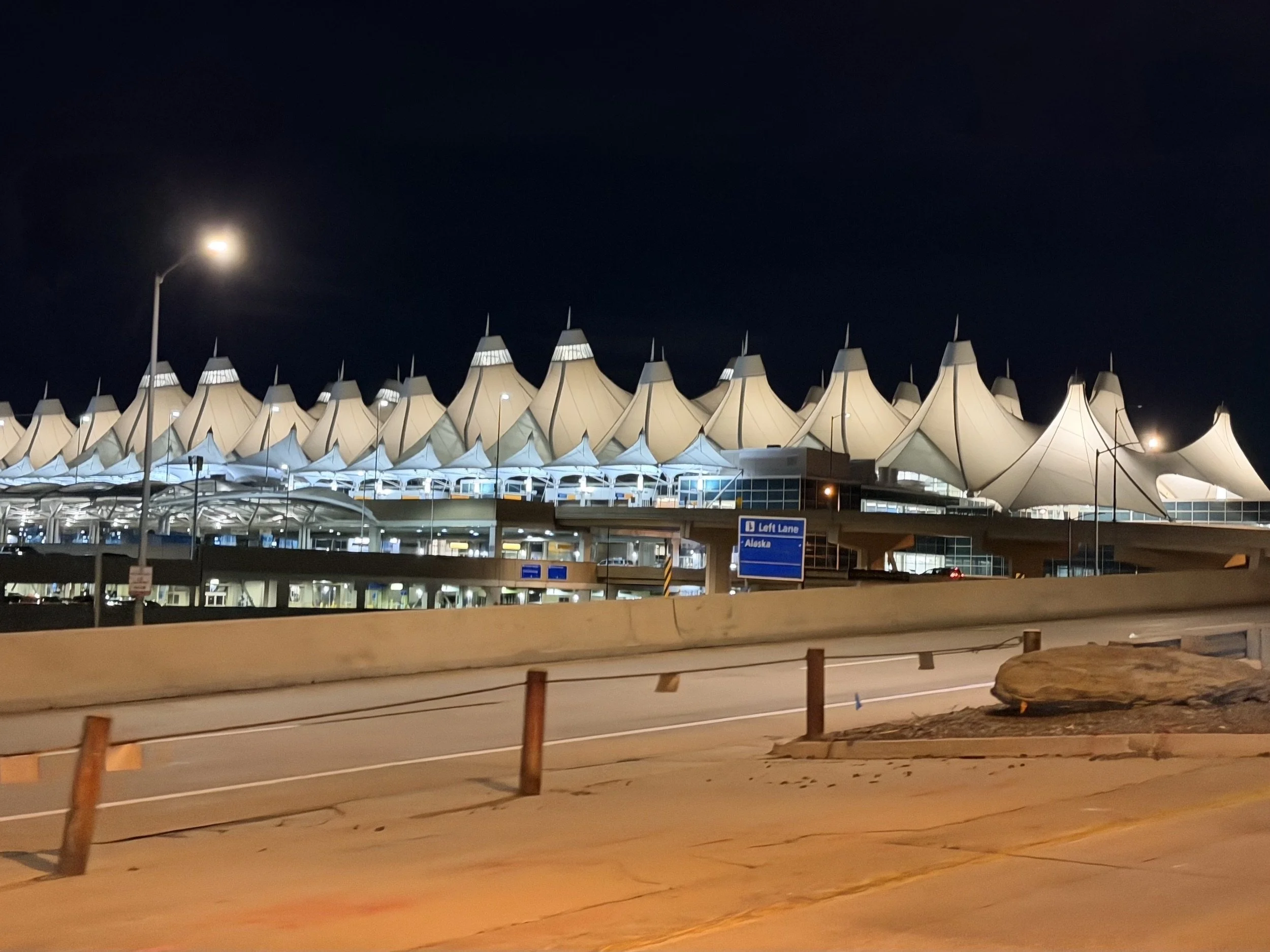
Since before it even opened in 1995, Denver International Airport—colloquially known as DIA, though it’s officially designated DEN—has exerted a strong pull on the imagination. Not surprisingly, the pandemic seems to have exacerbated that, with the cloud of conspiracy theories around it growing thicker in the 2020s. By then, DIA had already put a fake alien skull on display in a temporary art exhibit where it admitted that “no airport in the world has been the subject of such persistent and widespread conspiracy theories.”
It’s like the airport is Spook Central, that building in Ghostbusters that’s described as “a huge, super-conductive antenna that was designed and built expressly for the purpose of pulling in and concentrating spiritual turbulence.” The theories born out of that turbulence (no aviation pun intended) eventually gained enough momentum that The New York Times reported on them in an article *checks notes* published four years to the day after I first passed through DIA.
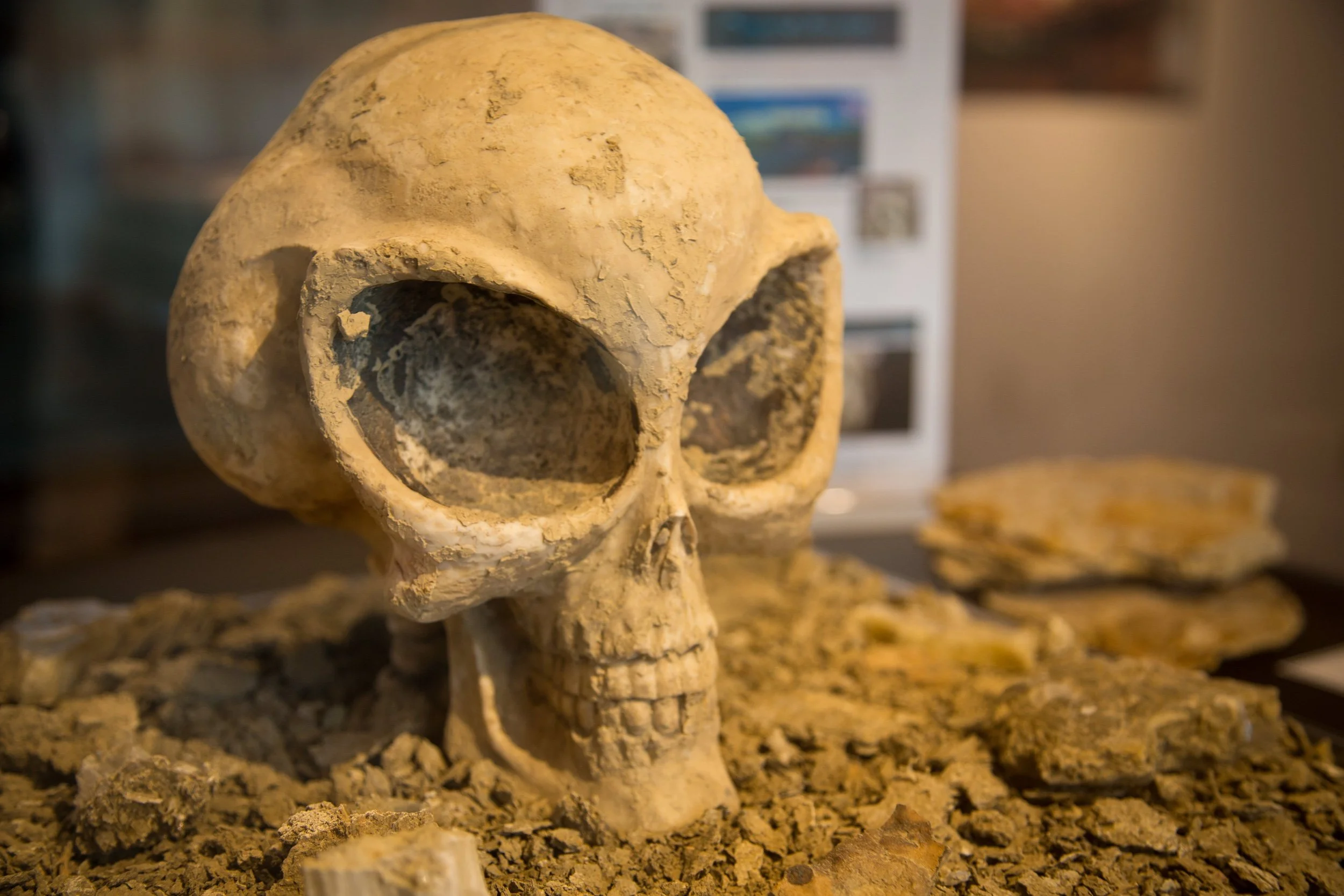
An “alien skull” displayed at DIA during the 2016 exhibition “Conspiracy Theories Uncovered.” Photograph provided courtesy of Denver International Airport.
Incidentally, “DIA” rhymes with “CIA.” And “spook” is slang for a CIA agent or case officer. Coincidence or conspiracy?
If you answered, “Conspiracy,” without missing a beat, then congratulations. You’re immediately qualified to investigate this airport, just as former Minnesota governor (and pro wrestler and Predator actor) Jesse Ventura once did on reality TV. DIA appeared in a 2010 episode of his docuseries, Conspiracy Theory with Jesse Ventura, where he also investigated the theory that the world would end with the Mayan calendar in 2012. It didn’t, obviously, but the airport still featured prominently in that theory as the location of a secret government bunker, built underground for elites to survive the impending cataclysm of solar flares.
Bonus points for suggesting that a subterranean tunnel connected it to the NORAD base at Cheyenne Mountain, where there’s also a U.S. Space Force station. The only problem with that theory is that the tunnel would need to be about 90 miles long to make it work. But hey, let’s not get hung up on details. The airport actually does have a network of underground tunnels, used for baggage handling, and it’s fun to think there might be lizard people down there, as some of the internet’s finest minds have deduced.
When you’ve got a long layover at DIA—as we did on our last trip through in January—you might as well see what all the hubbub is about by tracking down some of the unique public art that’s spurred on such theories. Be forewarned, however, that the airport’s baggage carousels are a place where gargoyles dwell. With a delayed flight, a damaged suitcase, and some positive flu tests on our return from Denver, we experienced enough bad luck this time that you’d almost think it was a mistake for me to have eaten that pentagram doughnut in DIA. Maybe the airport really is cursed, and every little coincidence is meaningful. Or not.
The Gargoyles of DIA, Greg and ‘Notre Denver’
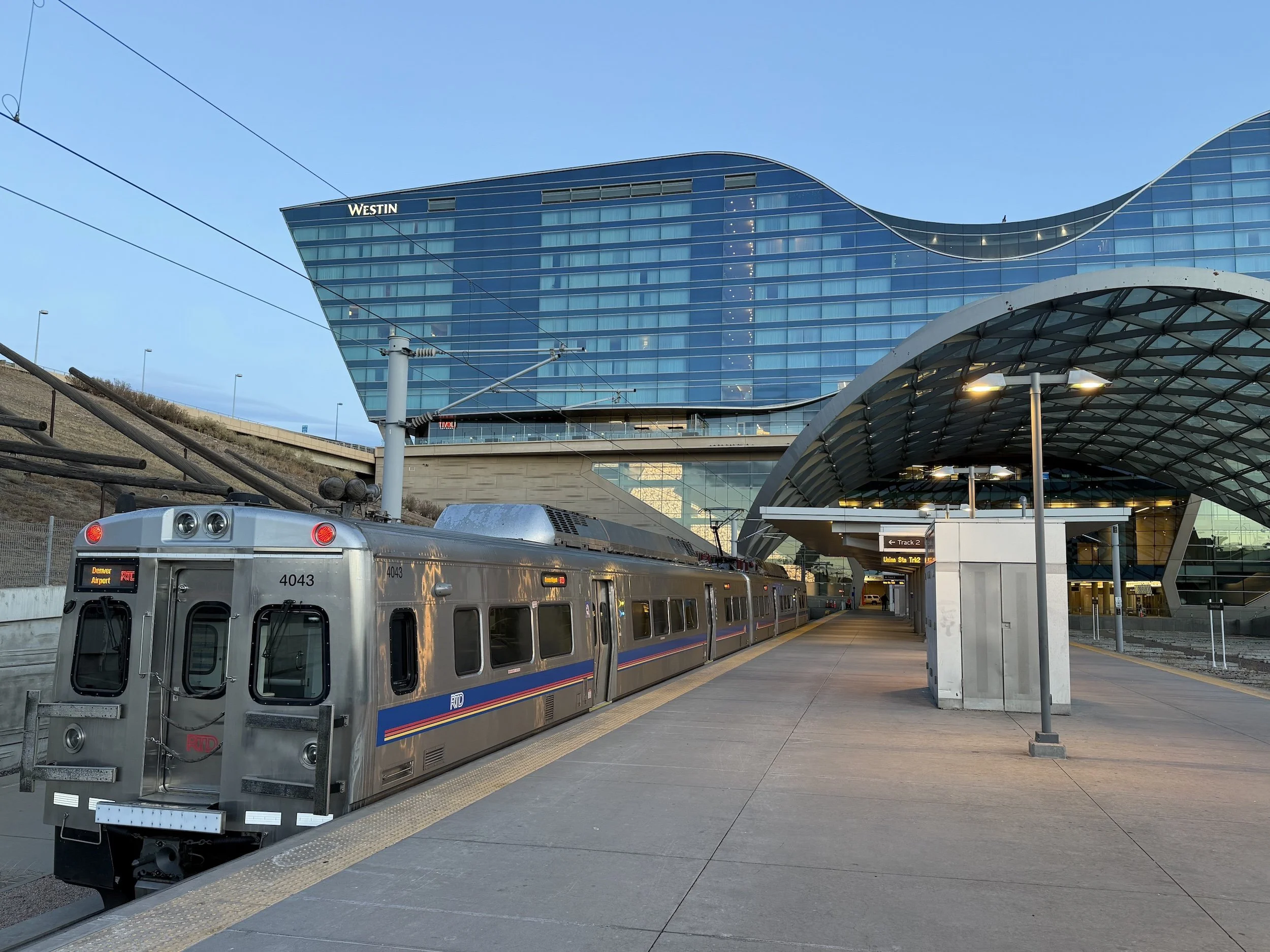
The 13th step of the Colorado State Capitol marks Denver as the Mile High City, and we had a 13-hour layover to explore the airport, its art, and the mile-high stack of wild ideas surrounding it. We arrived in DIA around 10 p.m., and our connecting flight was scheduled to depart around 11 a.m. the next day, so I had booked us a room at The Westin, which bills itself as “the only hotel directly connected to DIA’s Jeppesen Terminal.”
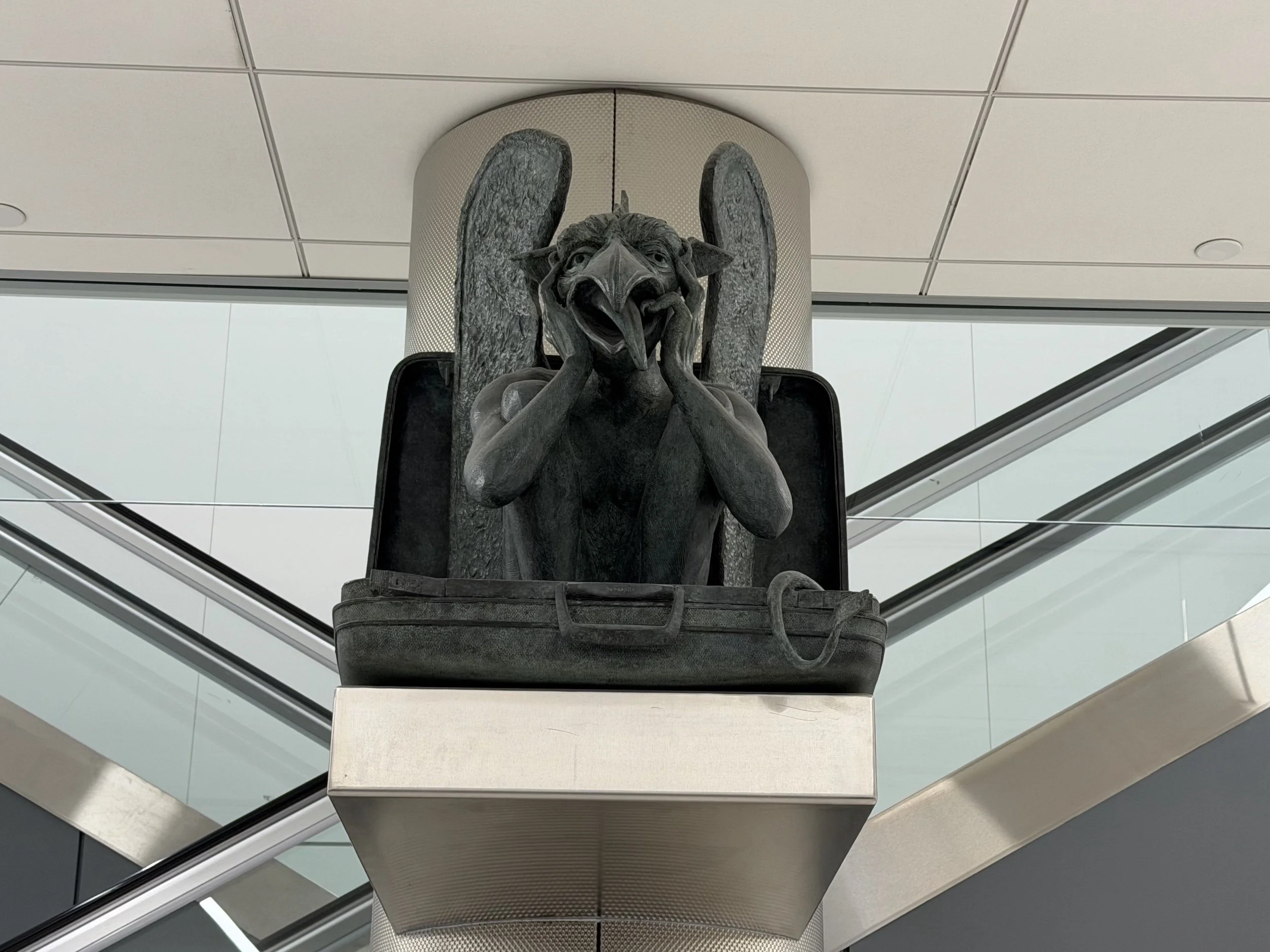
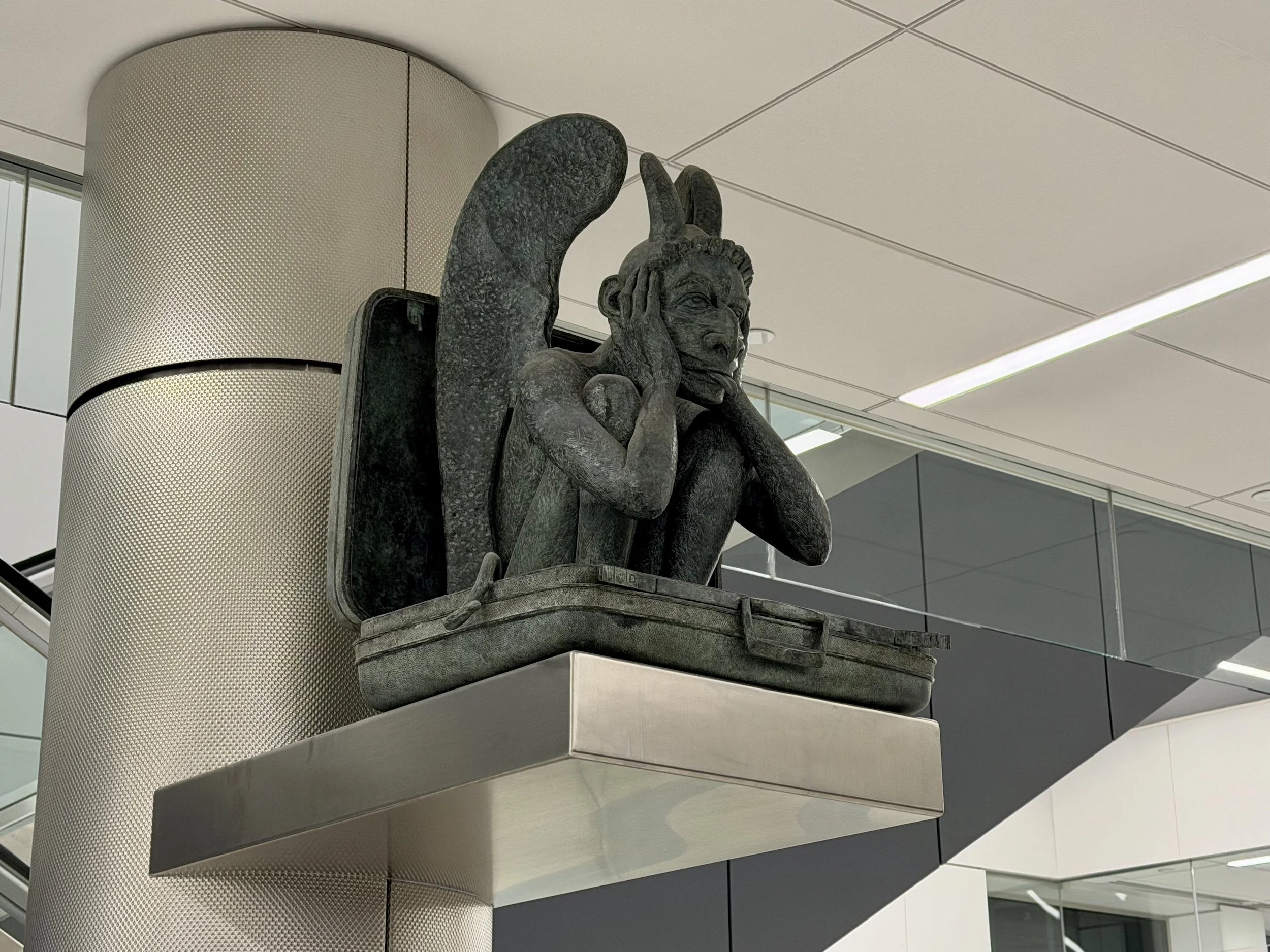
As I scooped up our suitcases from the baggage carousel, I spotted the first of the gargoyles. Terry Allen’s two cast-bronze sculptures, collectively known as “Notre Denver,” sit perched in Samsonite suitcases above the east and west baggage claim areas on Level 5 of Jeppesen Terminal. You don’t have to look very hard to find them. However, it’s impossible to find the talking animatronic gargoyle, Gregoriden, aka Greg, who used to startle passers-by at the airport by saying things like, “Welcome to Illuminati Headquarters.”
That’s because Greg was an installation whose day has come and gone. Some thought he was evil, and this is why we can’t have nice things.
It’s plain to see from YouTube footage, though, that Greg’s real-time interactions with people were those of a sophisticated puppet, like you’d see in a show involving audience participation at Disney World, such as Monsters Inc. Laugh Floor. (A hyper-specific example that I share only because I was once singled out as “that guy” in the audience.) You’d have to be operating without a sense of humor to take anything he said seriously. Then again, maybe playing it off like a joke is all part of the conspiracy.
For its part, DIA is swift to remind people that gargoyles are supposed to ward off evil. The ones atop Notre Dame Cathedral in Paris also serve a practical purpose, acting as rain gutters. You could say they’re true gutter mouths, but that’s neither here nor there. On the airport’s website, the “Notre Denver” page reads:
“Historically, gargoyles were placed on buildings to protect the site. Denver International Airport’s gargoyles sit slightly above travelers’ heads to help ensure the safe arrival of baggage.”
No word yet on whether DIA’s gargoyles transform into terror dogs, as the statues in Ghostbusters did. However, it would seem the spell of protective gargoyle magic doesn’t extend to the safe departure of baggage. When we got back to Tokyo and reclaimed our baggage there, we were surprised to find that one of our suitcases was split open and was now missing a wheel. It was damaged in transit between Denver and Tokyo, but when we went to the United Airlines desk, a representative there immediately produced a catalog and let us choose a free replacement for them to deliver.
It All Goes Back to the Freemasons *Sarcastic Voice*
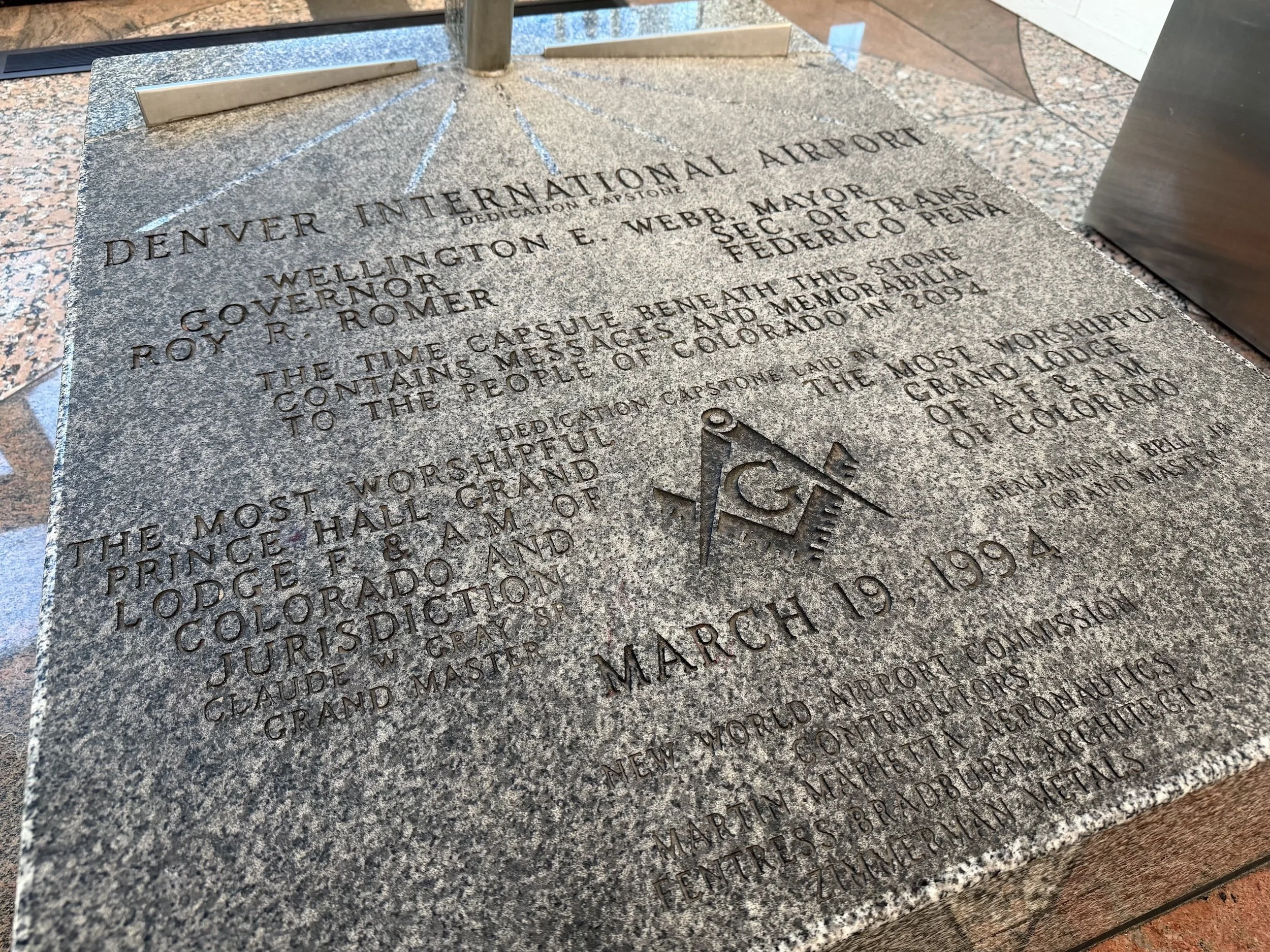
Greg’s glib “Illuminati” reference wouldn’t land as a total non sequitur to anyone who’s ever read a Dan Brown novel, like “Angels & Demons,” which Time Magazine once ranked among the top 10 airplane books. At Jeppesen Terminal, right by the door that leads out to The Westin and the escalator to the train platform, you’ll see DIA’s infamous 1994 dedication capstone. It features the Masonic “Square and Compasses” symbol, along with an inscription referring to two local lodges whose names are a mouthful.
On the left, you’ll see “The Most Worshipful Prince Hall Grand Lodge F. & A.M. of Colorado and Jurisdiction.” The “F. & A.M.” there stands for “Free and Accepted Masons,” as you can see on the lodge’s official website, which further reveals that their jurisdiction includes Utah and Wyoming. On the right, you’ll see the similarly named “Most Worshipful Grand Lodge of A.F. & A.M. of Colorado,” whose middle initials stand for “Ancient Free and Accepted Masons.”
The inscription says there’s a time capsule beneath the capstone with “messages and memorabilia to the people of Colorado in 2094.” At the bottom, below the dedication date, it also shows the name of a mysterious organization called the “New World Airport Commission.” If you believe the theories, this is the smoking gun that proves DIA is part of the emerging New World Order.
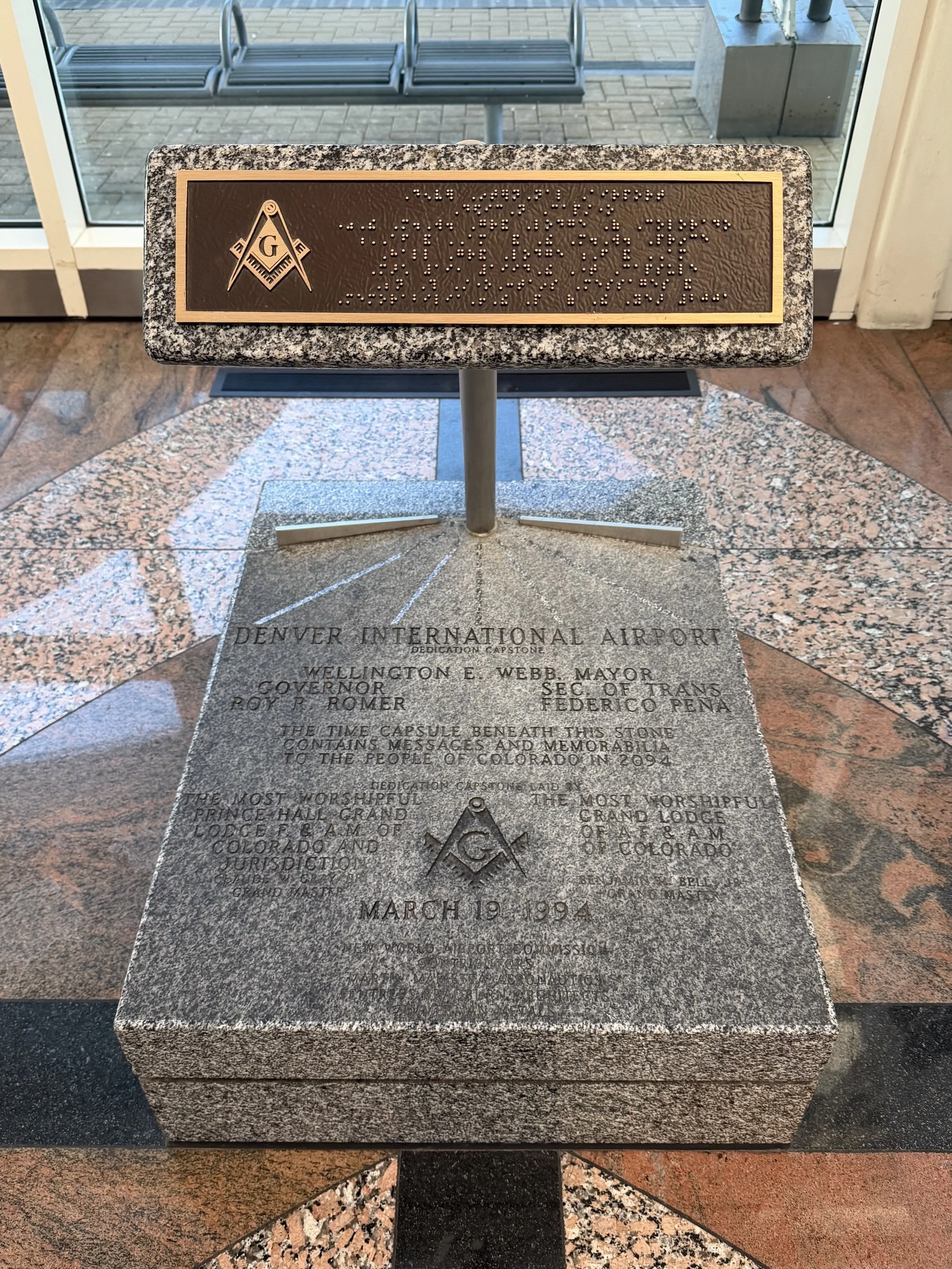
The New World Airport Commission was a real promotional organization with enough bylaws and other records to fill eleven boxes in the Denver Public Library’s archives. It’s tempting to think they and their name were already in on the joke at DIA, but according to the library, the commission was formed by one Charles Ansbacher, a conductor for the Colorado Springs Symphony. He named it after Dvorak’s “New World Symphony,” a piece of music that greatly influenced the iconic, two-note shark theme in the movie “Jaws.”
The commission was mainly concerned with planning the airport’s opening festivities. That’s why the records only cover the (unlucky?!) 13-year stretch between 1986 and 1998, the years before and just after DIA opened.
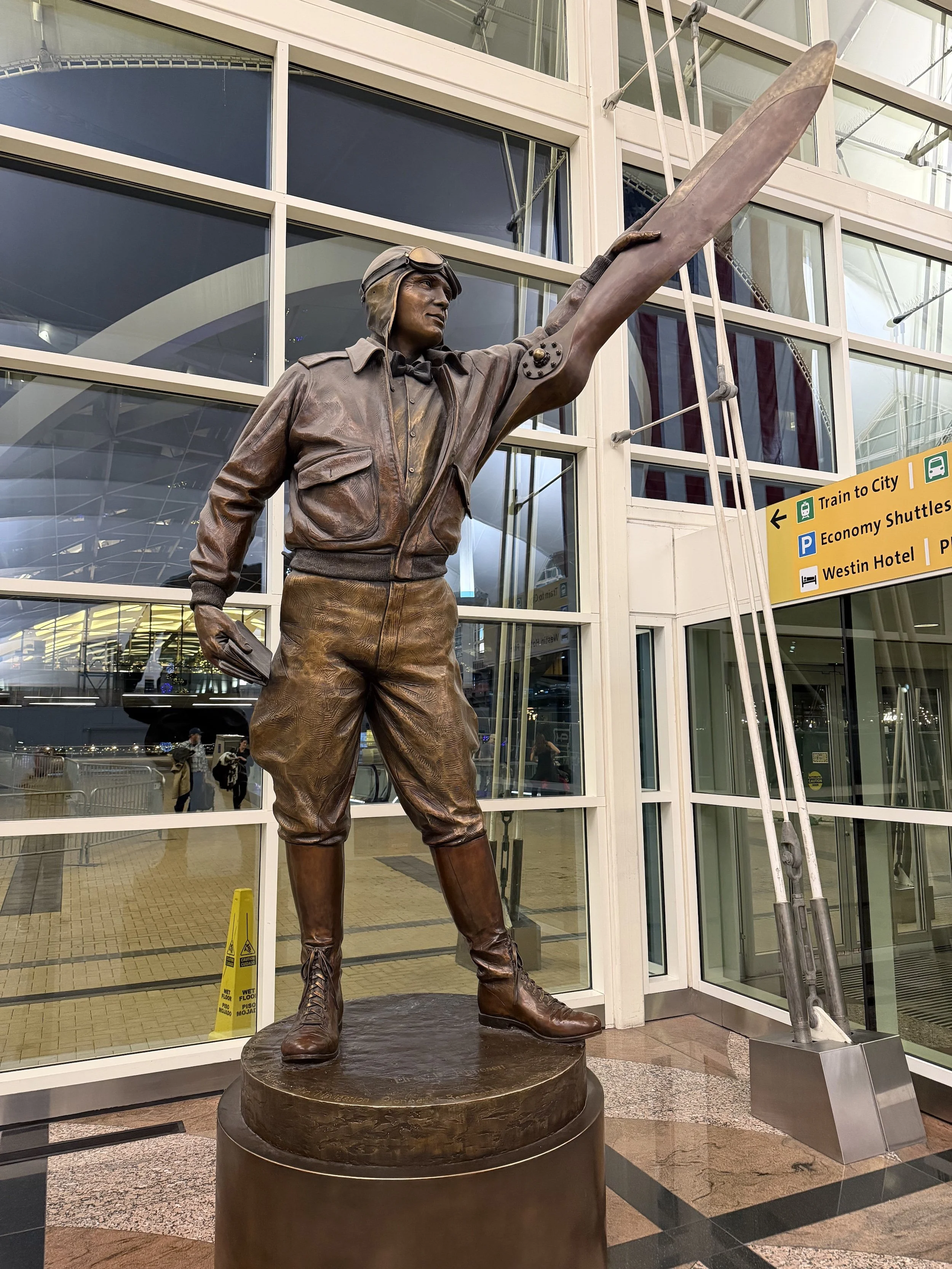
Make of that what you will. Also, when you check out the capstone, don’t miss the Elrey Jeppesen sculpture on the other side of the door. Created by George Lundeen, it’s a tribute to the aviator for whom Jeppesen Terminal is named.
Built by Nazis, Too, Apparently
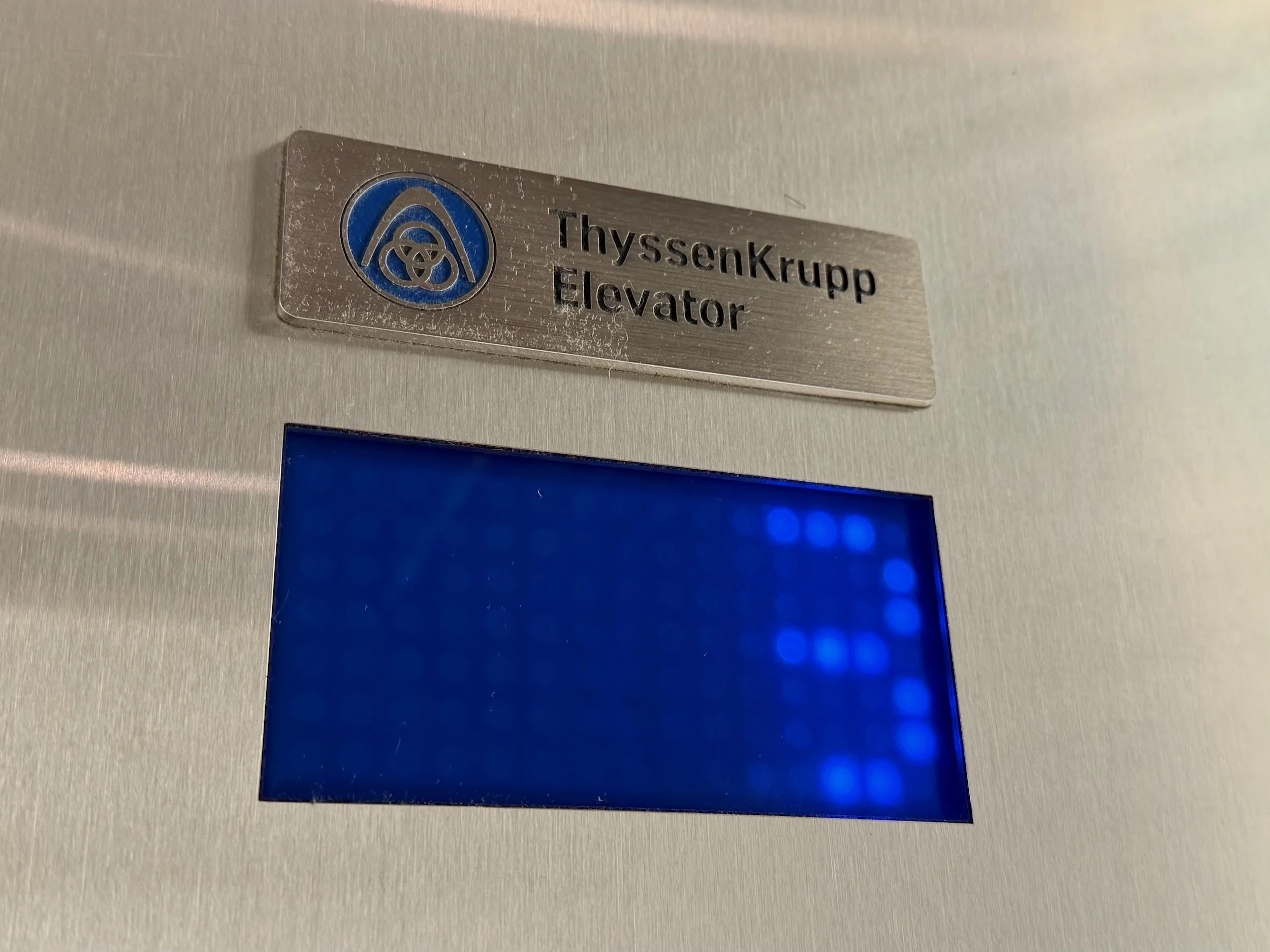
While it’s odd to see that the Freemasons have left their literal mark on DIA, I was personally more taken aback by the history behind another symbol I saw on the elevator up to our room at The Westin. Above the floor number display, there was a three-ring logo with the name ThyssenKrupp under it. It turns out ThyssenKrupp is a German industrial conglomerate, which formed out of a merger between two different companies, one of which, Krupp, served as Germany’s largest weapons manufacturer during both World Wars.
John Bonham, the drummer whose death broke up the band Led Zeppelin, chose a symbol very similar to ThyssenKrupp’s logo to represent him on the cover art for the band’s fourth album. This is the album that yielded “Stairway to Heaven,” one of the rock songs accused of Satanic backmasking back in the 1980s. Maybe that’s the reason ThyssenKrupp’s logo seemed vaguely occult-like amid the swirl of theories connected to the airport’s enigmatic art pieces.
Speaking of World Wars, another theory is that DIA’s pinwheel of six runways forms a massive swastika when viewed from the air. To test this theory, I’m not sure if it would be enough to just look out the window as your plane takes off or lands. You might need to call up satellite imagery of the airport on Google Earth, drawing lines through the grid to connect the separate runways, as Vice did. Or just look at my own screenshot below.
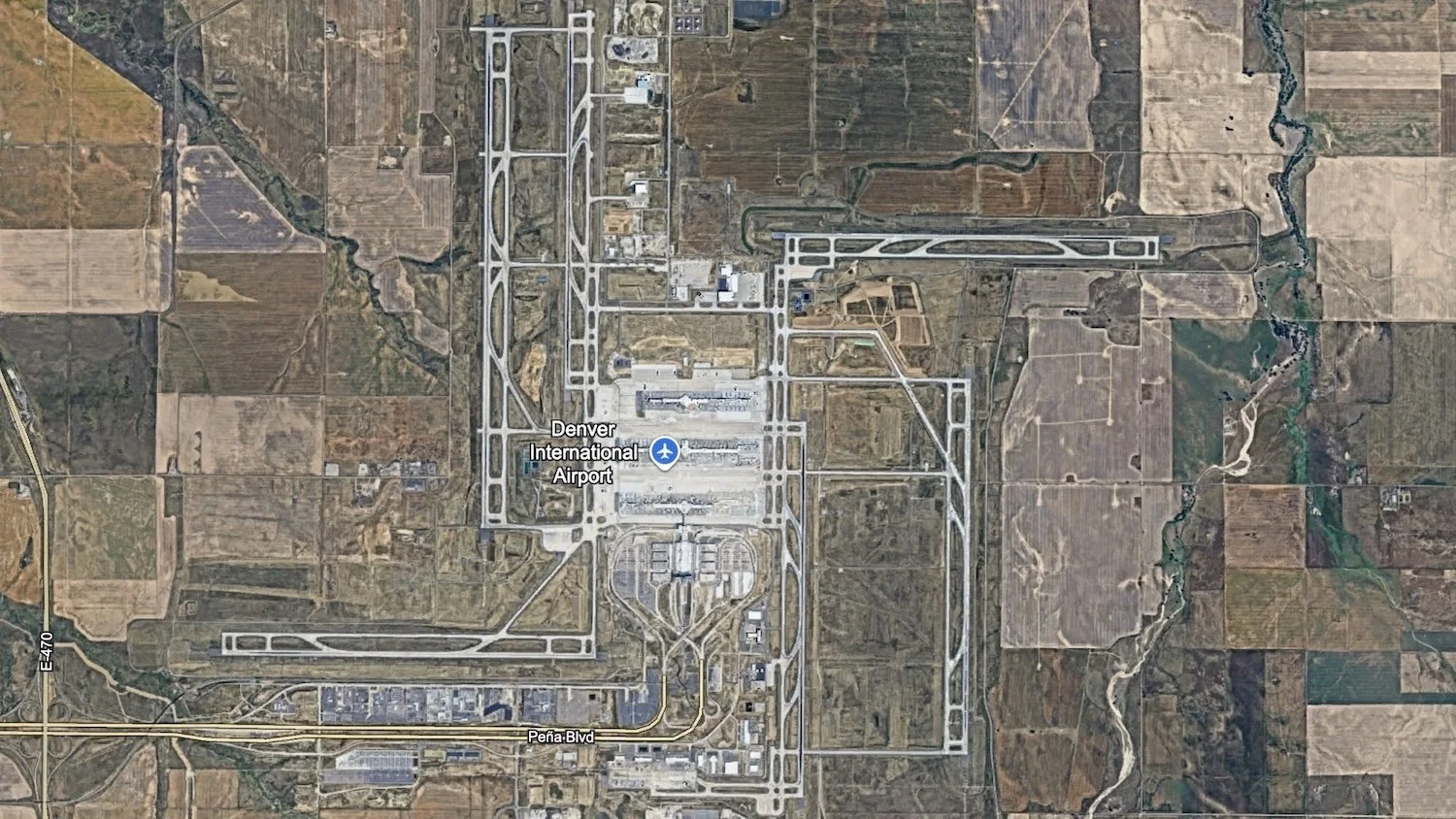
Google Earth screenshot showing the pinwheel-shaped layout of DIA’s runways.
Looking at that with the suggestion of a swastika already implanted in your brain will surely have the same effect as if I played you “Stairway to Heaven” backwards and told you to listen for the words, “Here’s to my sweet Satan.” It’s a kind of confirmation bias based in apophenia and pareidolia, where your brain’s connecting the dots the way it would with the Virgin Mary’s face on a grilled cheese sandwich. Knowing that rationally can still go against a person’s instincts, leaving them unable to say whether there’s really something there or whether it’s just false pattern recognition.
Airport representatives told FOX31 Denver that DIA’s runways are designed the way they are to handle wind patterns and reduce noise disturbances. Alas, mundane explanations like those may never be enough to quell the curiosity of the conspiracy minded. As someone who probably has some delusional tendencies of his own, I understand all too well what it means to perceive connections with great meaning in unrelated phenomena. Yet I can’t shake the feeling that there’s no grand unifying theory of the supposed dark forces behind DIA. It’s more like the airport, the artists exhibited there, and every tinfoil hat on the interweb have collectively decided to throw everything at the wall and see what sticks.
Hail a ride (not Satan) to see ‘Mustang,’ aka Blucifer
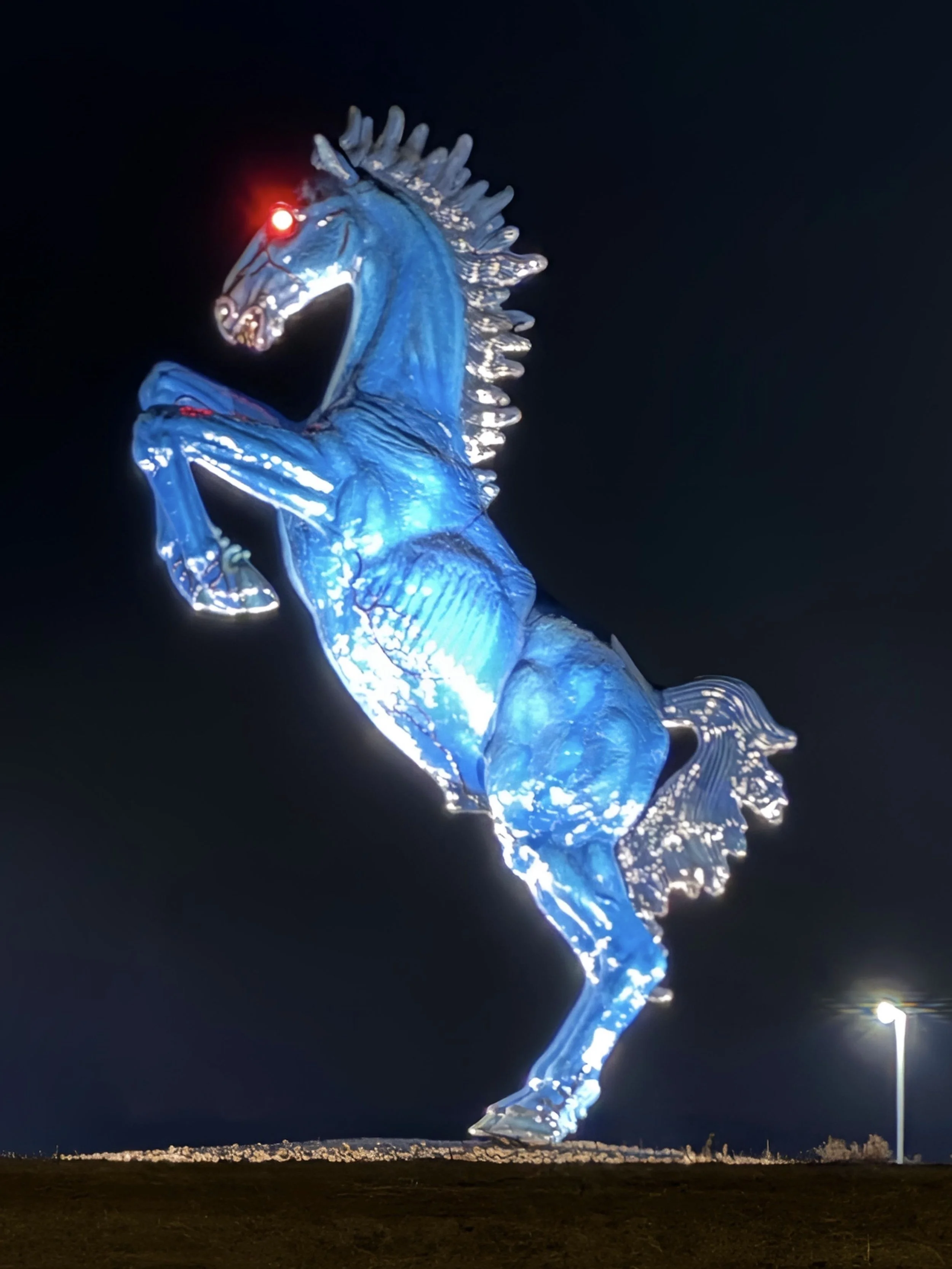
There’s one piece of public art that you can only see from a distance at DiA. That’s “Mustang,” the striking—some would say demonic—blue horse sculpture that provided our lead-in. It stands on the median in Peña Boulevard, which loops around in front of the airport, but there’s no pedestrian path leading out to it. Unfortunately, that means you can’t get up close to the horse to take pictures, look up its nostrils, or see details like its private parts. For anyone on a layover like we were, your best bet for seeing “Mustang,” aka Blucifer, would probably be to hail an Uber or Lyft ride.
In our room at The Westin, I couldn’t sleep, so I went back down and did that around 2 a.m. The pick-up area for ride-sharing services is right near the cab stand outside the airport, but I wouldn’t recommend taking a taxi. When I walked up to the line of cabs and asked about doing a quick loop around Peña Boulevard, the first couple of drivers each quoted me some outrageous price, like $65 or $75. I don’t know if that’s because they would have lost their place in line or what, but I ended up just using the Uber app to summon a ride instead.
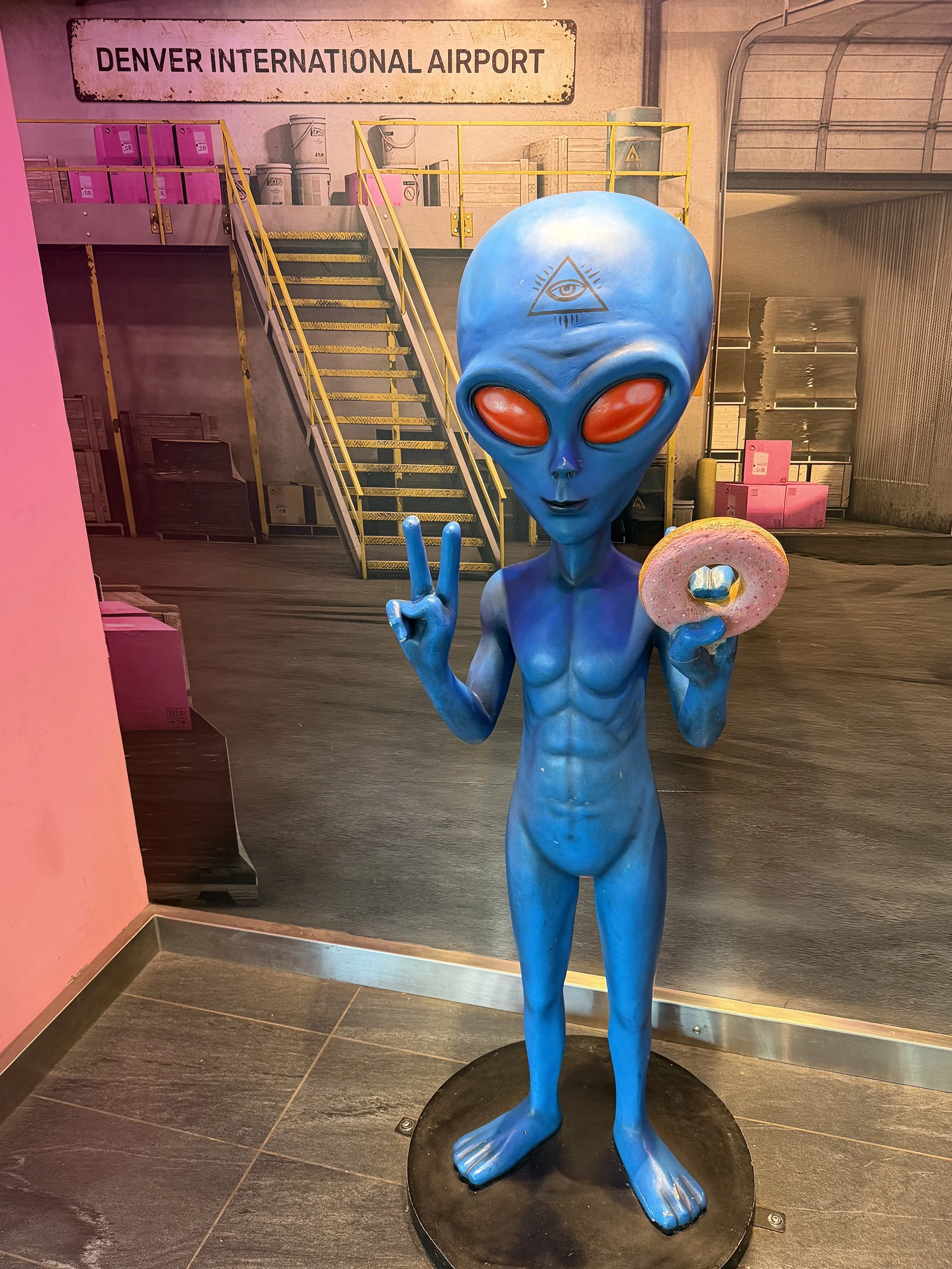
It still cost me upwards of $25 after the tip, but I got lucky, because the mission to see “Mustang” appealed to my somewhat excitable driver, who was all too eager to show off this point of interest. Since it was the wee hours of the morning and there were few cars on the road, she even slowed down, then offered to pull over and put on her emergency blinkers for a second as we passed “Mustang.” I’m not sure that was legal; you might get a ticket if you try to do that in a rental car, especially during the daytime. But it did allow me to get better pictures of the sculpture than I would have if I were shooting out the window of a moving car at night. Later, I would see an alien in the airport with the same blue-skinned, red-eyed color scheme as “Mustang,” but I’m getting ahead of myself.
“Mustang” was created by Luis Jimenez, who admittedly suffered some irrevocable bad luck when he was completing the sculpture in his home and a piece of it came loose, falling on him and severing an artery in his leg. This accident, sadly, was fatal, which only adds to the sculpture’s mystique. As the story goes, the horse’s glowing red eyes were really meant to be a tribute to Jimenez’s father and his neon sign shop. That’s the reason they’re red, though they did once spook Jimenez himself when he was home alone at night and his real-live horse, Black Jack, broke into the house.
Susan Jimenez, his widow, told Colorado Public Radio: “You're afraid of something but then it’s OK [because you realize] it is familiar. I don’t know. But the eyes do not have any evil intent whatsoever.”
In the video above (via the Smithsonian in Washington, D.C.), you can see “Mustang” in progress and hear Jimenez talking about some of his other works. Putting a face to the name and remembering that this was a real person, not just a character in a story, might help serve as an antidote to the sensationalism of DIA lore. Despite the horse’s sinister appearance, reports that “Mustang” will shoot you with his laser-beam eyes appear to be greatly exaggerated. I could find no evidence of their veracity other than an unnamed man who told The New York Times that he used to spook his kids with that story.
‘Dual Meridian,’ ‘Children of the World Dream of Peace,’ and Voodoo Doughnut
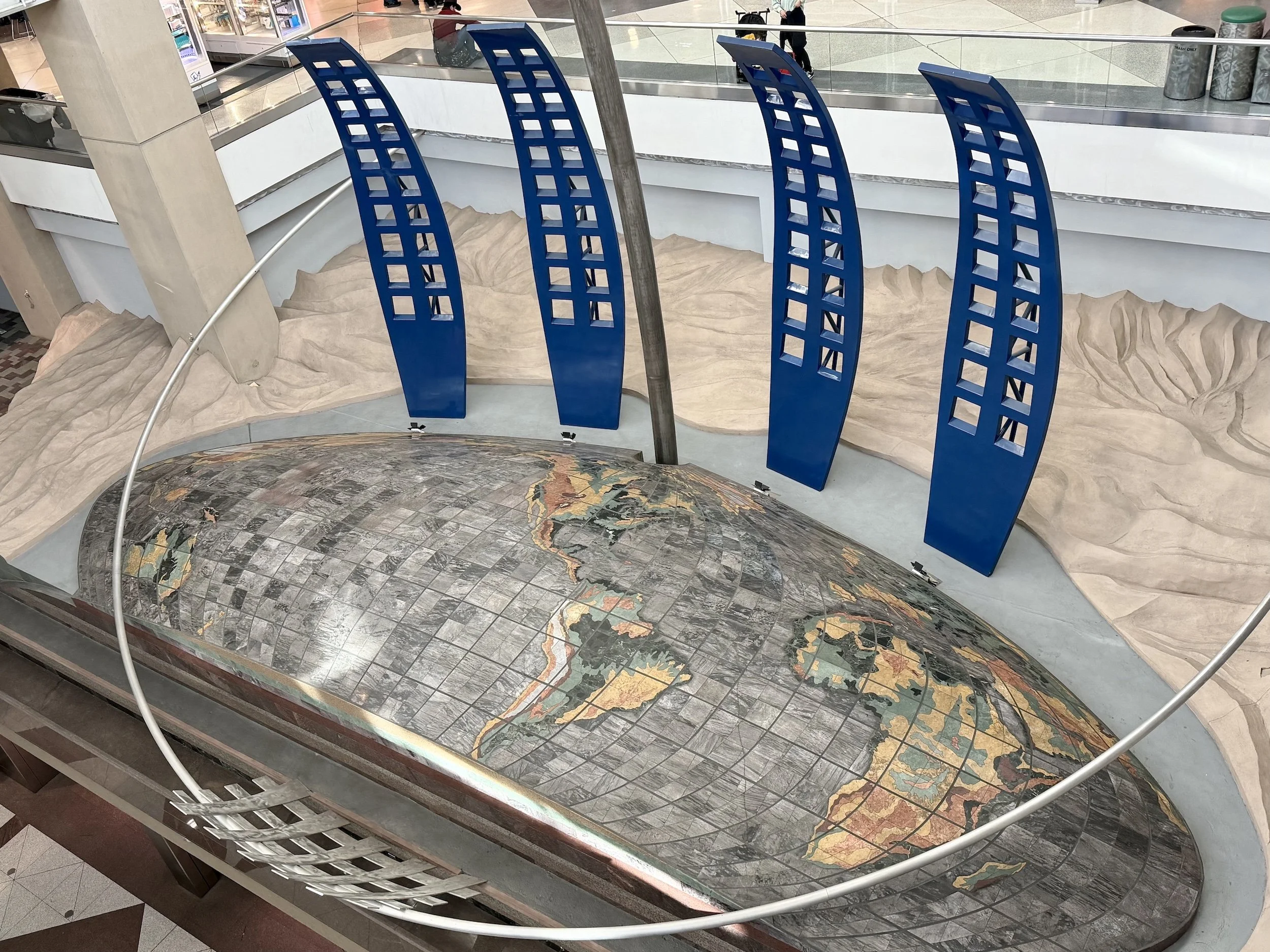
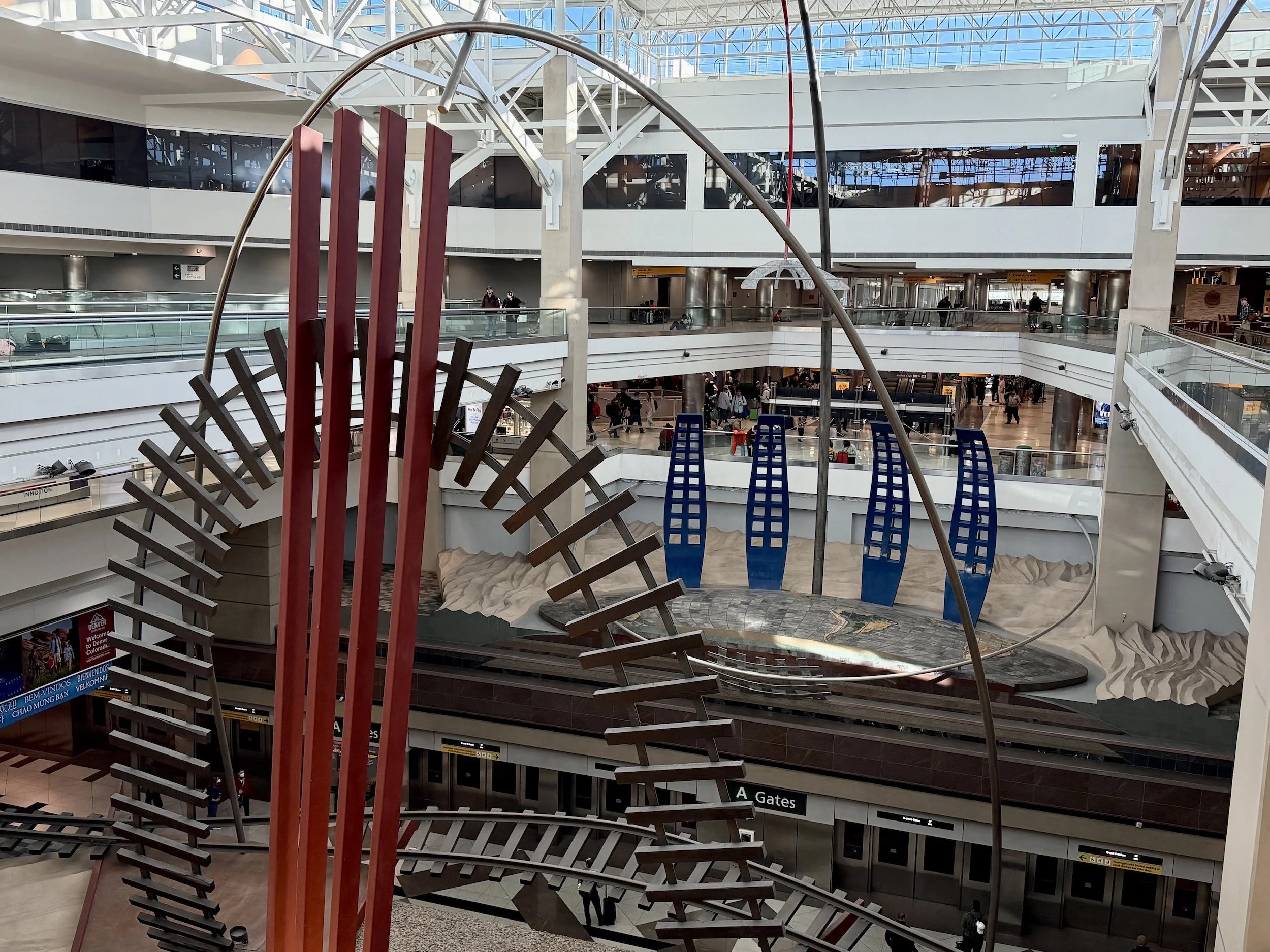
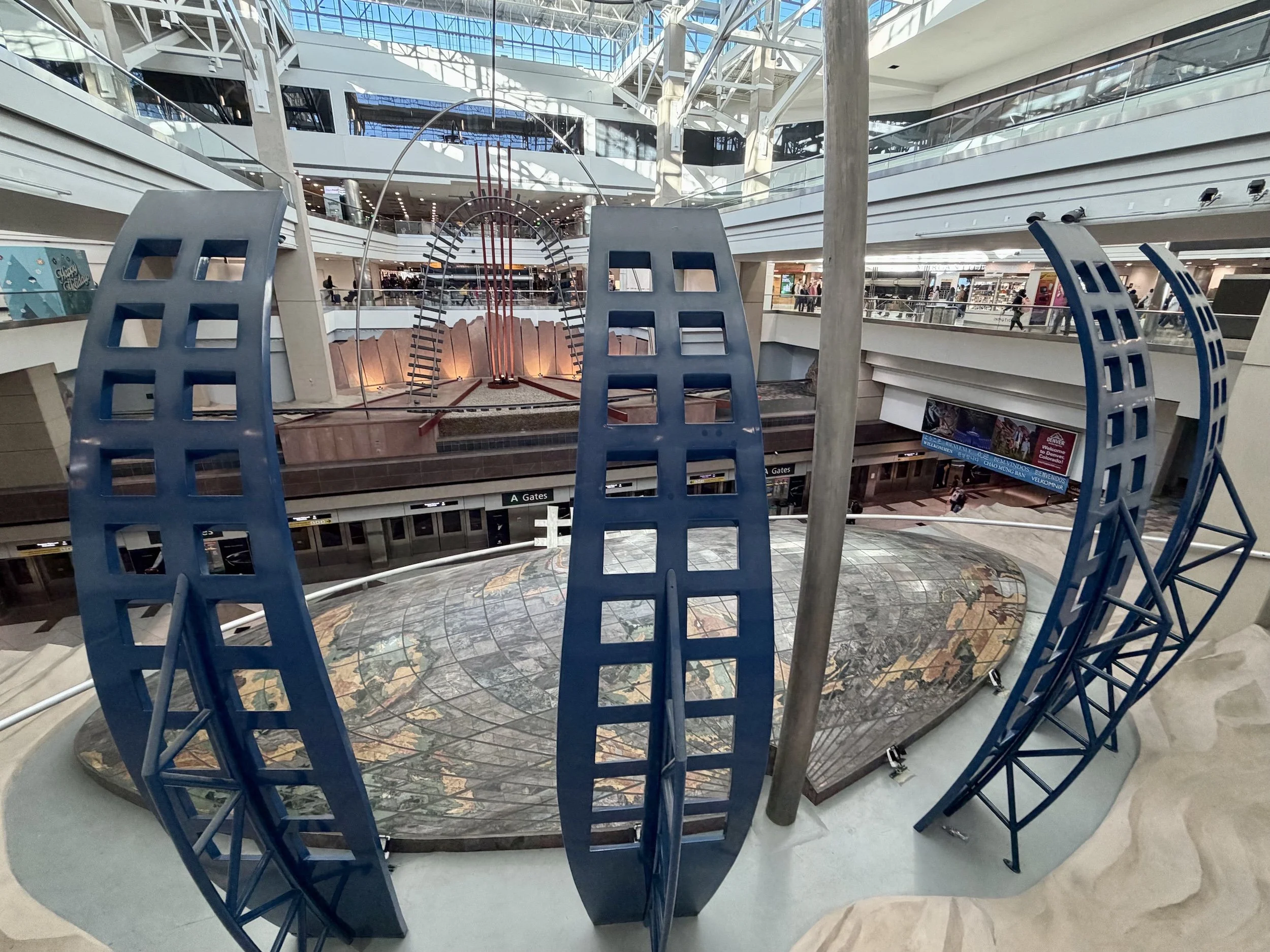
From a plane window above Denver, you should be able to confirm with your own two eyes that the earth has curvature and is not, in fact, flat. In 2023, however, claims began making the rounds on TikTok that a new piece of public art in DIA, featuring train tracks and a global map on raised tiles, somehow vindicated the flat-Earth conspiracy theory. The transportation-themed artwork is called “Dual Meridian,” and you’ll find it in the center of Concourse A, which is linked to Jeppesen Terminal via a pedestrian bridge.
There’s just one issue with those TikTok claims. Artist David Griggs created “Dual Meridian” in 1994, per Denverite. So, in reality, it’s been in the airport since it first opened and isn’t at all new. For that matter, neither is the idea of a spherical earth, which philosophers and mathematicians accepted even before the time of Christopher Columbus, as The Washington Post notes.
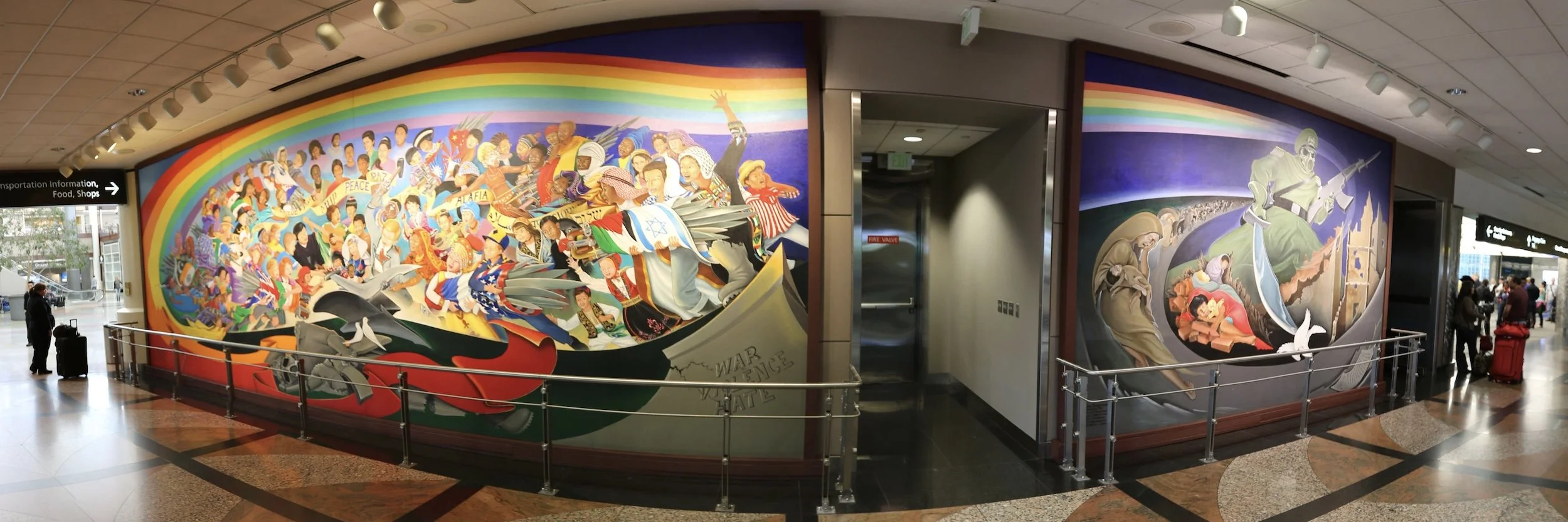
Currently in storage: “Children of the World Dream of Peace” by Leo Tanguma. Photograph provided courtesy of Denver International Airport.
Leo Tanguma’s mural, “Children of the World Dream of Peace,” has also been fodder for conspiracy theories, but it was put into storage in 2018 when DIA began undergoing a lengthy renovation that won’t wrap up till next year. Even though it’s been out of sight for eight years, it’s still inspired end-of-the-world theories, based on the image of a gas-masked soldier in Gestapo garb oppressing the dove of peace. That’s on the short side of the mural, but if you step to the left when it returns circa 2027, you’ll see that the long side of it shows children and doves, triumphing over war, violence, and hate under a rainbow.
Part of what fuels theories about DIA is its far-flung location in the plains outside Denver proper. By its own admission (via a 2019 press release), the airport has “chosen to lean into the theories” as a tongue-in-cheek marketing gag. It and Roswell International Air Center have jokingly announced themselves as “supernatural sister airports” with plans for “extraterrestrial-combat.”
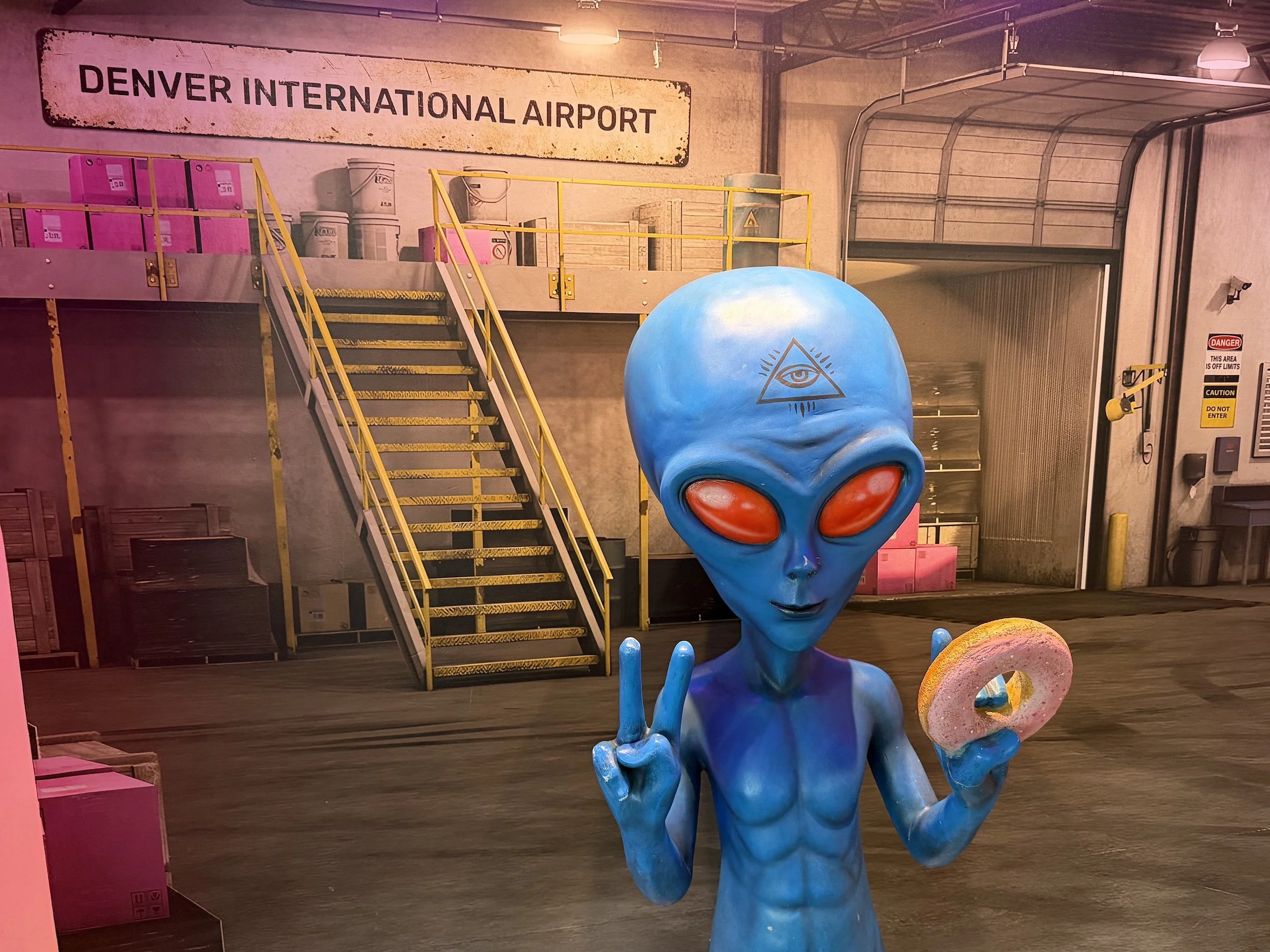
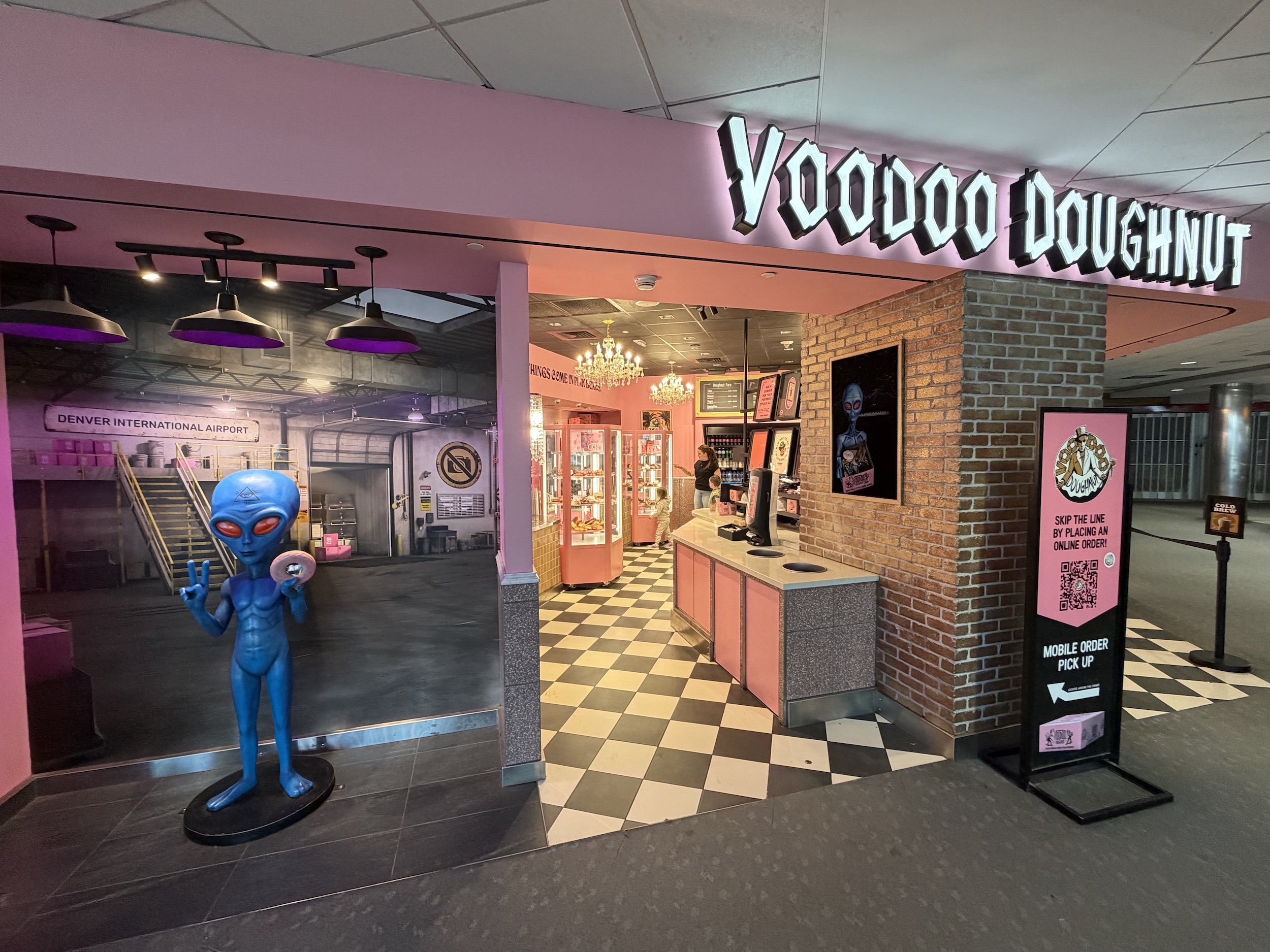
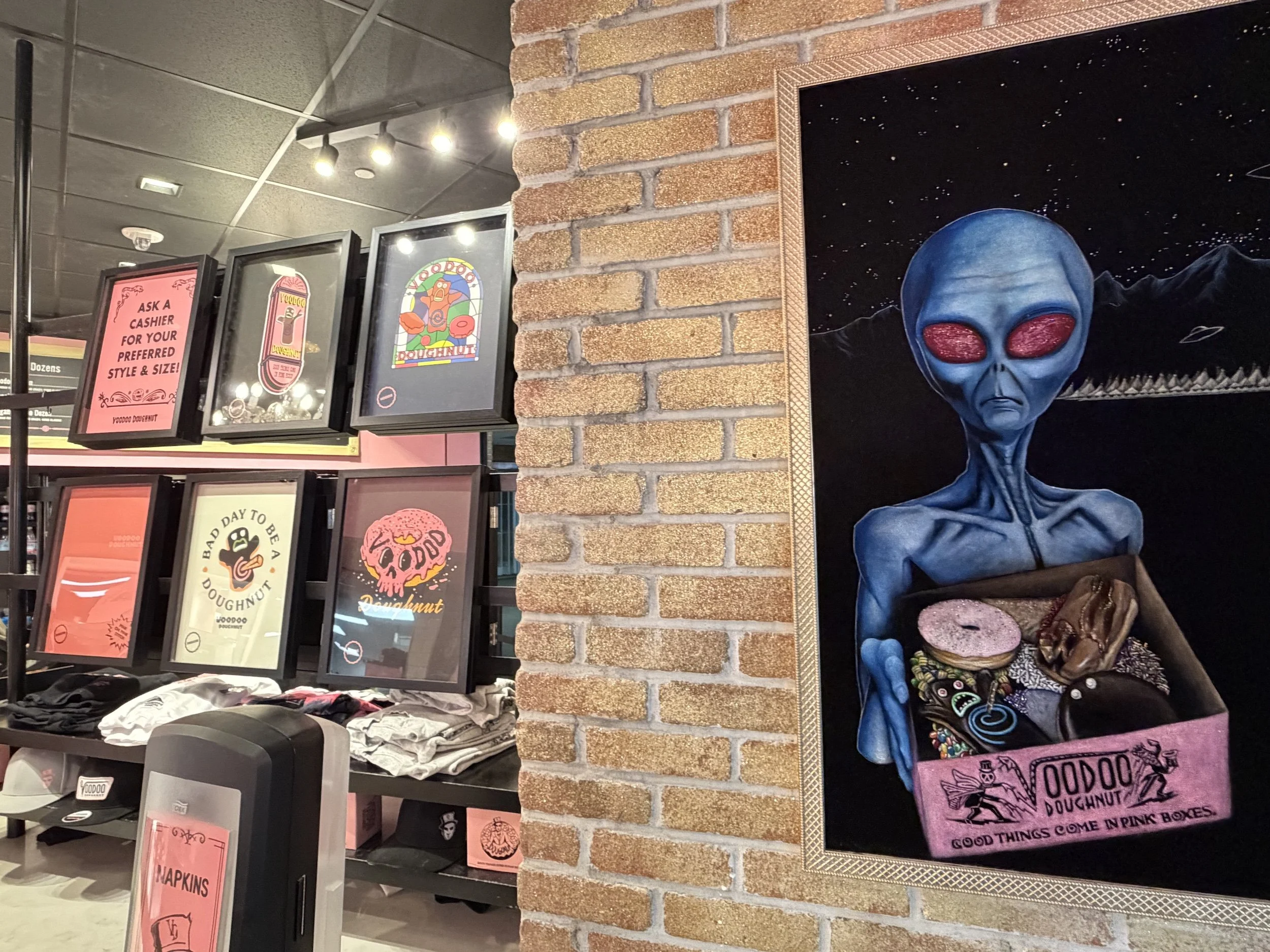
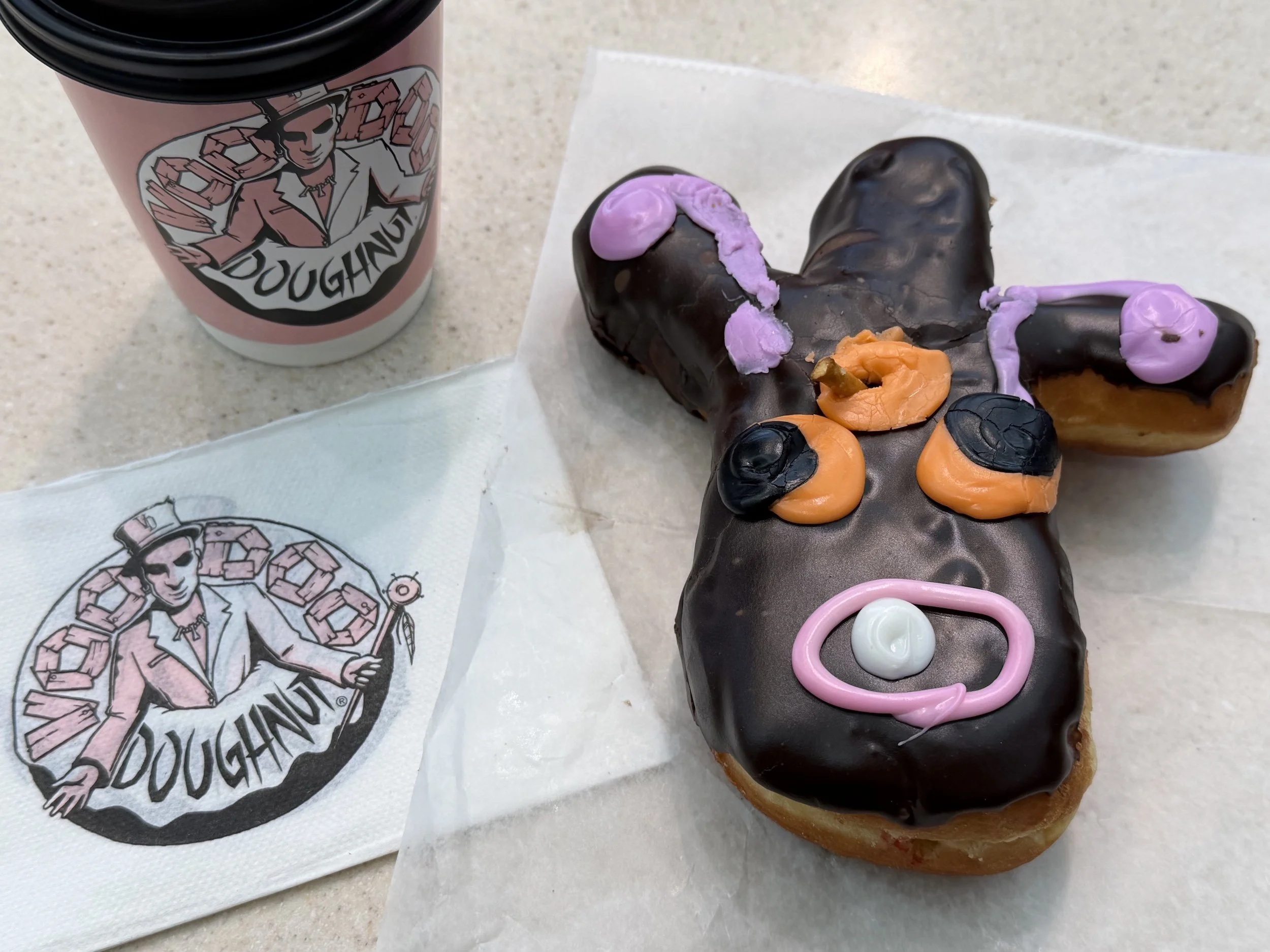
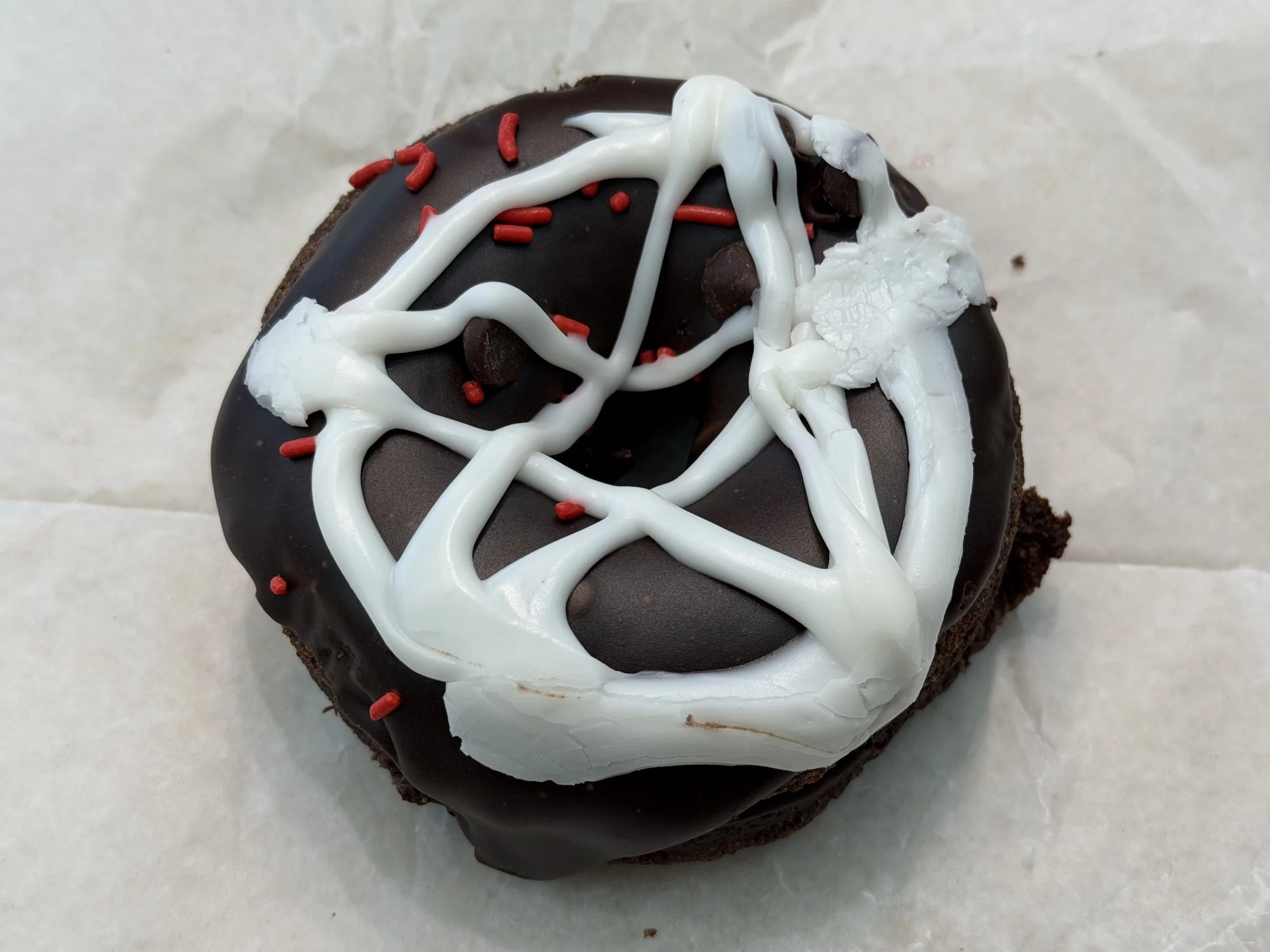
As it happens, you can see an alien in DIA, even posing for selfies with it. The photo op is in the center of Concourse B, up on the mezzanine level outside Voodoo Doughnut. When this Portland-based chain started expanding beyond Oregon, it opened its first out-of-state branch in Denver. The founders set out to achieve “world doughnut domination,” so maybe they’re part of the New World Order like the Freemasons. According to The Los Angeles Times, they used to openly sell doughnuts laced with Nyquil, and really, what better way to sedate the masses in a fast-food nation?
Whatever the case, I ordered the Voodoo Doll, a raspberry-filled chocolate doughnut, and the Diablos Rex, a devil’s food cake doughnut with a vanilla frosting pentagram. This was our last stateside meal, and to the extent that I am superstitious, I fully believe its emblems of witchcraft brought disaster on my family. The oversized doughnuts made my wife nauseous the more she ate, and she and my daughter both tested positive for the flu after we got back to Tokyo. I also felt sick and had a fever, though I had gotten a flu shot earlier in the winter and tested negative.
A gateway to Denver and the history of flight
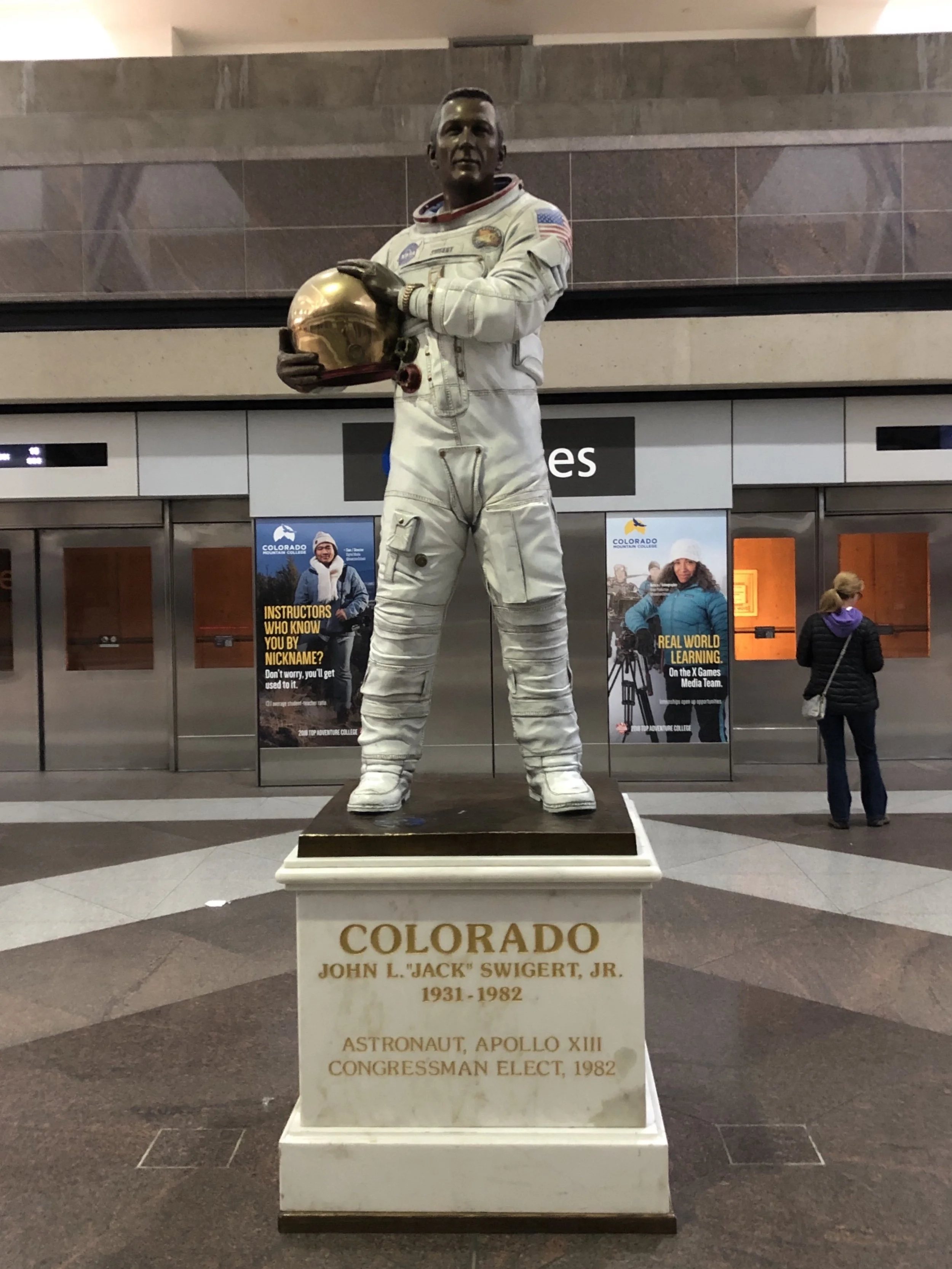
As mentioned, our return flight out of DIA was delayed, but only for an hour or so. Having a little extra time allowed me to seek out some of the other public art creating a visual impression of aviation history in the airport. This includes a train platform statue of Jack Swigert, the Apollo 13 astronaut and Denver native who famously said, “Houston, we’ve had a problem” (often misquoted as, “Houston, we have a problem.”)
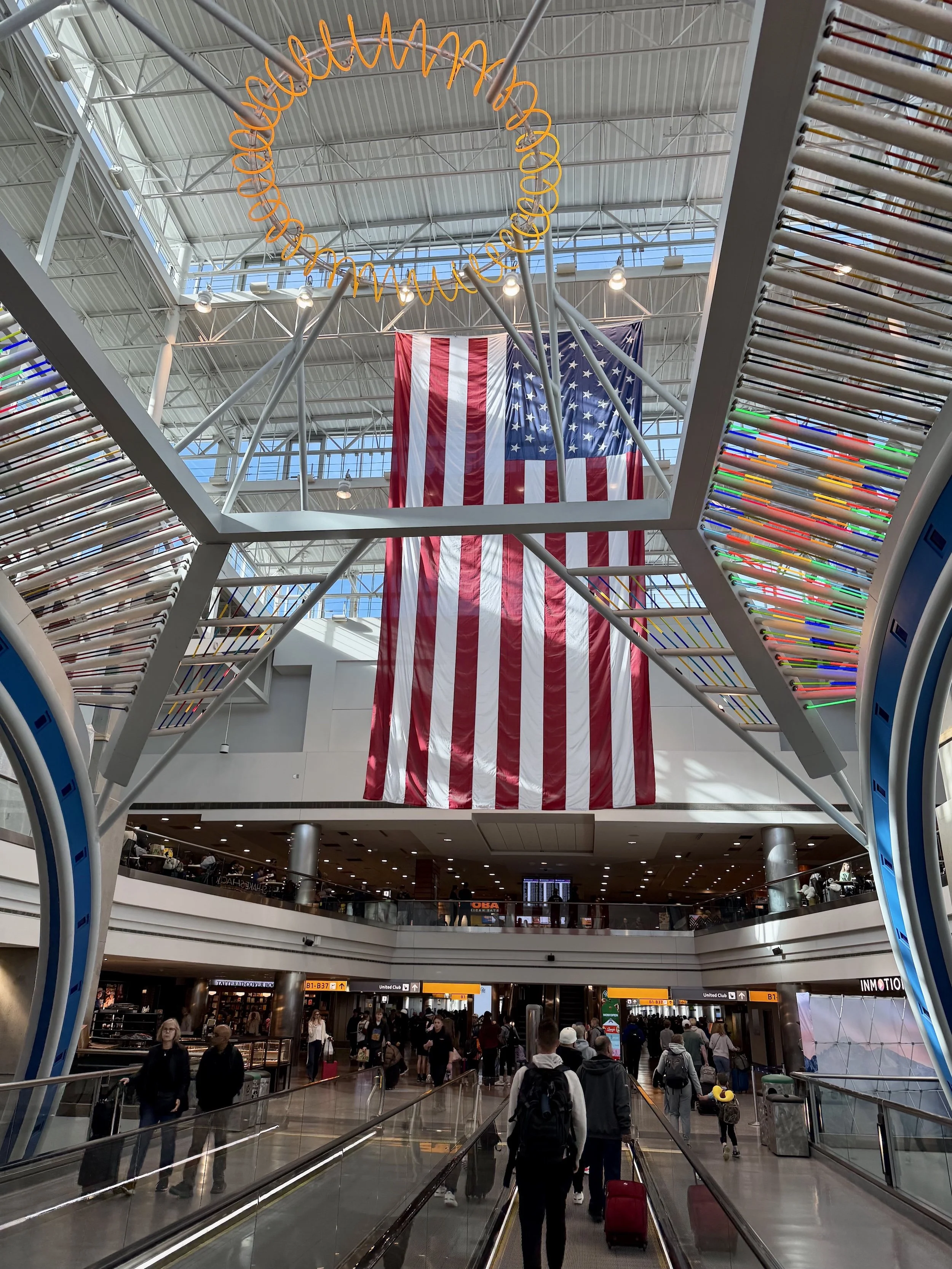
“Beaded Circle Crossing” by Alice Adams gives an abstract nod to “the lodges, tipis and beadwork of Native Americans,” though the giant American flag hanging over it draws attention away from its “iridescent screens of spliced colored-glass tubes” as the real visual centerpiece in Concourse B. It’s worth mentioning that the white tents that form DIA’s roof are likewise inspired by tipis (or teepees), along with the snow-capped Rocky Mountains. Based on the lack of any historical evidence, however, the theory that the airport is built on an ancient Indian burial ground probably owes more to horror movie tropes and colonialist guilt than anything else. (One of the many movies to employ that trope is The Shining, but more about that film in a second.)
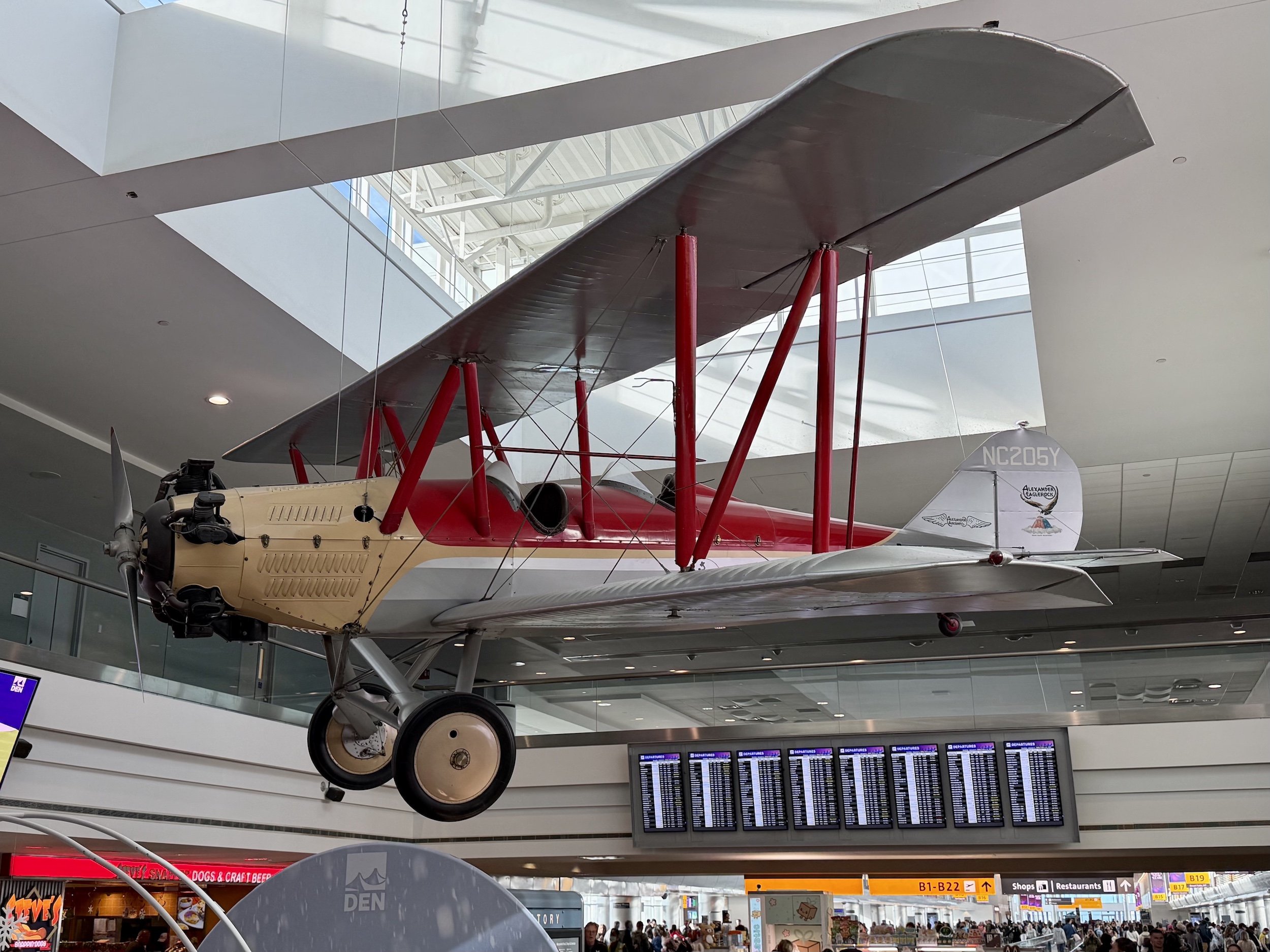
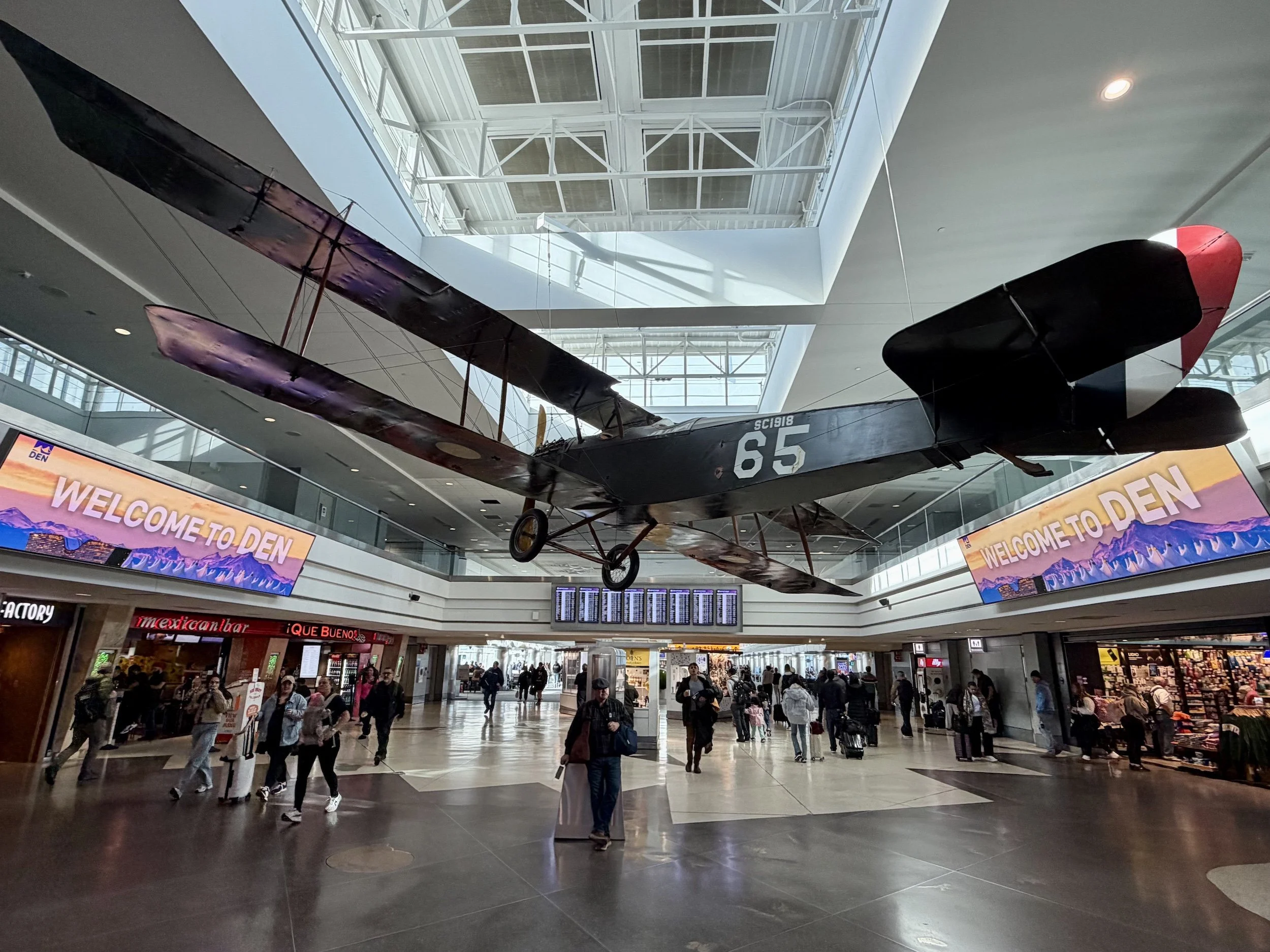
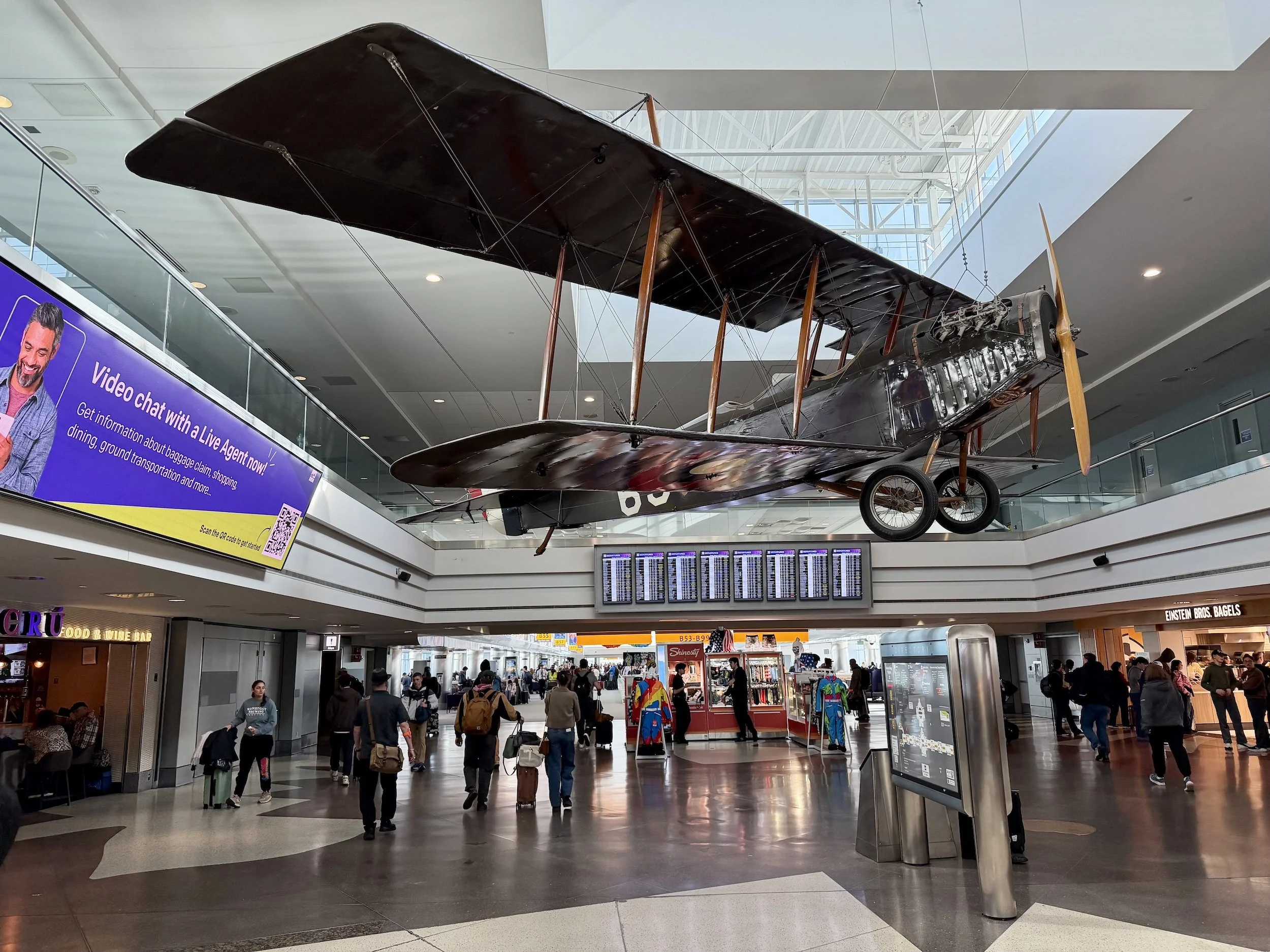
Elsewhere in Concourse B, you can see a biplane suspended from the rafters—with the airport identifying it on Facebook as a “restored 1930 Alexander Eaglerock Model A-14.” An even older relic in the same concourse is the 1918 Curtiss Jenny JN-4D, the type of plane that flew the first air mail between New York and Washington, D.C.
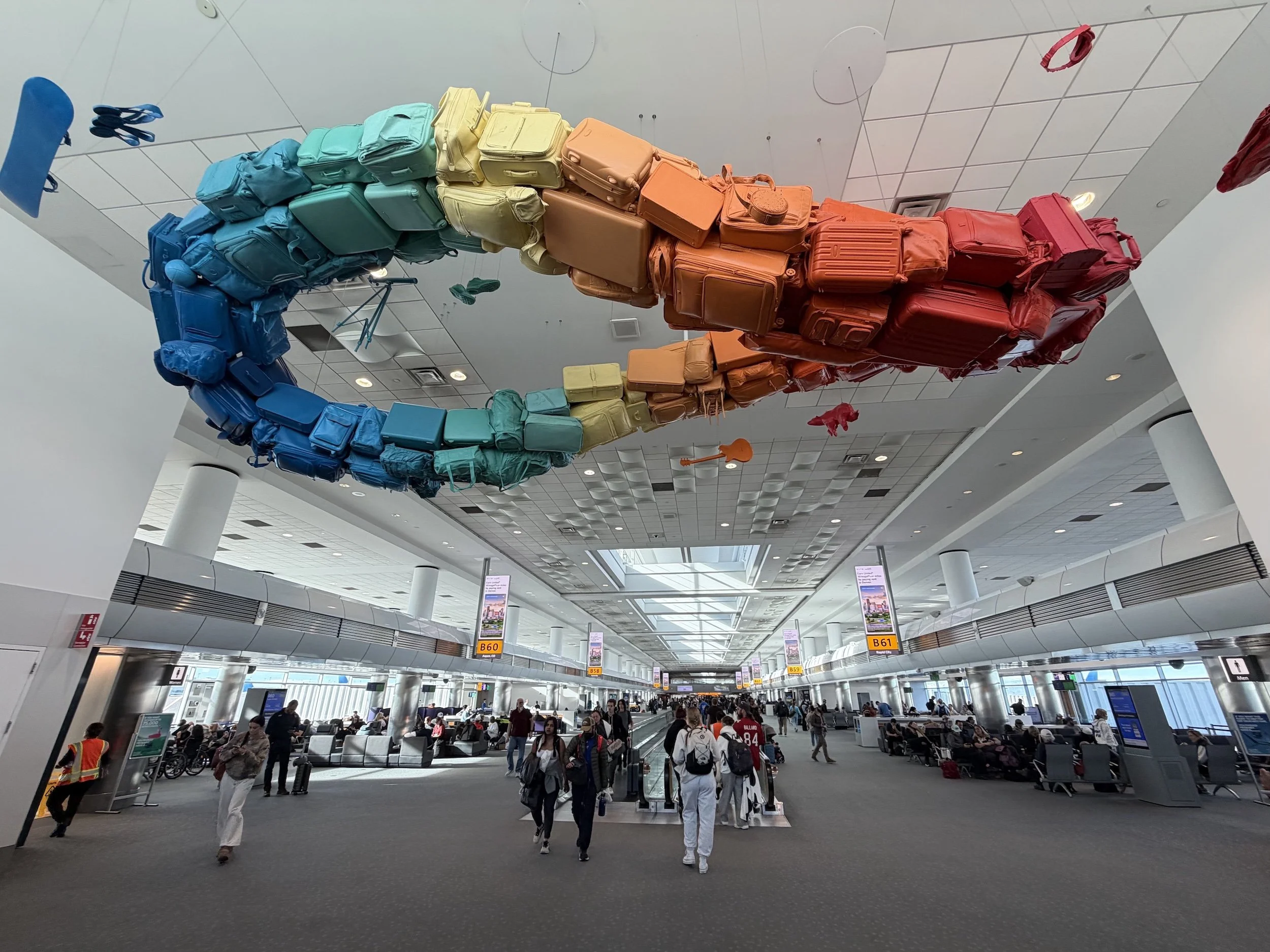
Another interesting piece that hangs overhead (near gate B60) is the colorful “It’s Not What You Take, It’s What You Bring Back” by Thomas “Detour” Evans. This work consists of over 180 pieces of luggage, transformed into bright art in DIA.
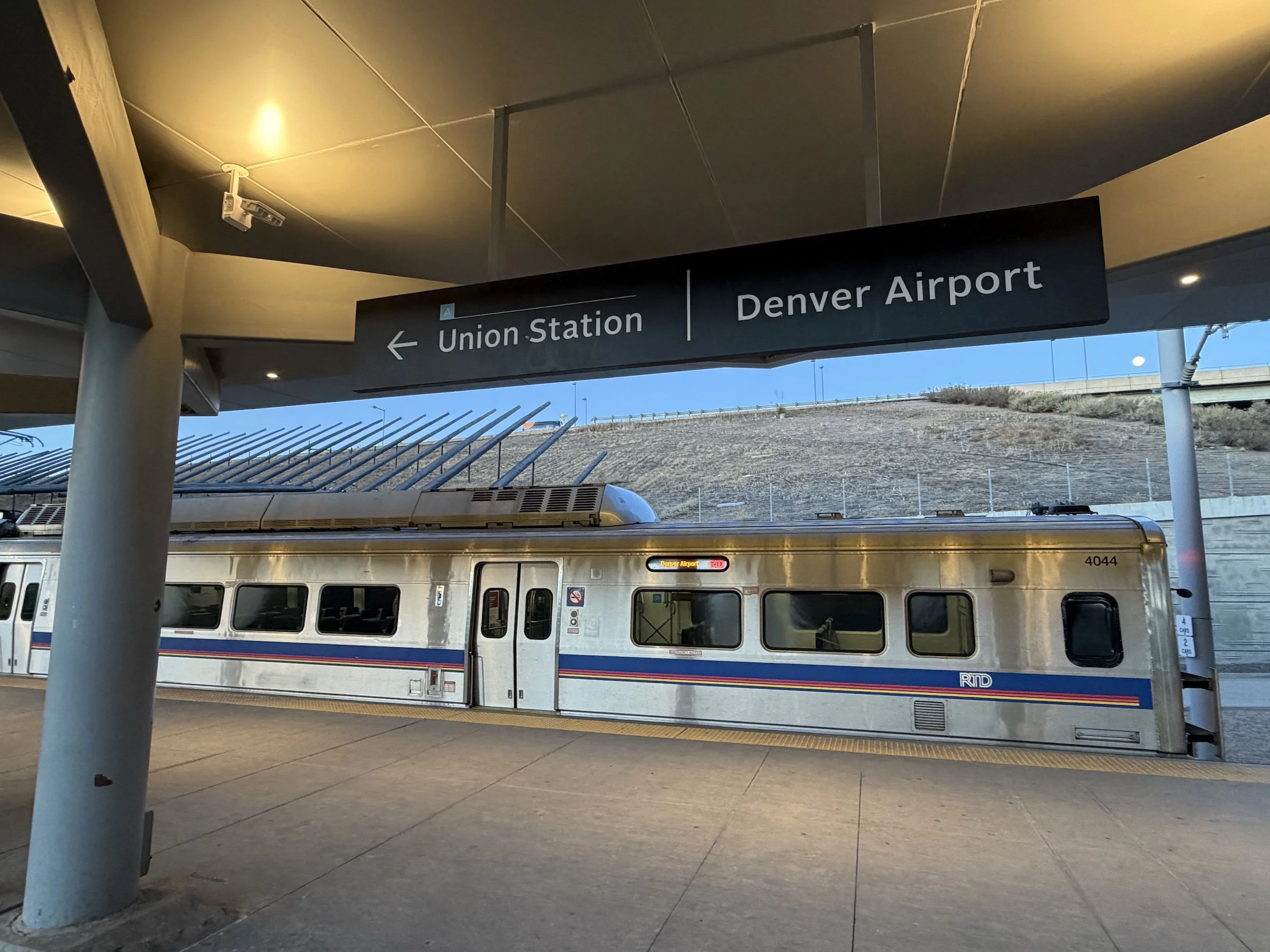
In August, I’ll be passing through DIA again on a much shorter layover, and maybe then I can grab an Illuminati Shake from Little Man Ice Cream in Concourse C. In the future, I’d also like to spend more time in and around Denver, taking the train from the airport to Union Station, then maybe linking up with a van tour to Rocky Mountain National Park. My Uber driver this time hailed from nearby Estes Park, where the Stanley Hotel is located. This is the hotel that inspired Stephen King’s bestselling horror novel, The Shining. It later served as the filming location for the TV miniseries adaptation of his book.
What’s weird is that a director named Stanley (Kubrick) handled the original film adaptation of that book. And the hotel has a ballroom called the MacGregor Room, and an actor named (Ewan) McGregor later starred in Doctor Sleep, the sequel to The Shining.
Clearly, another conspiracy …
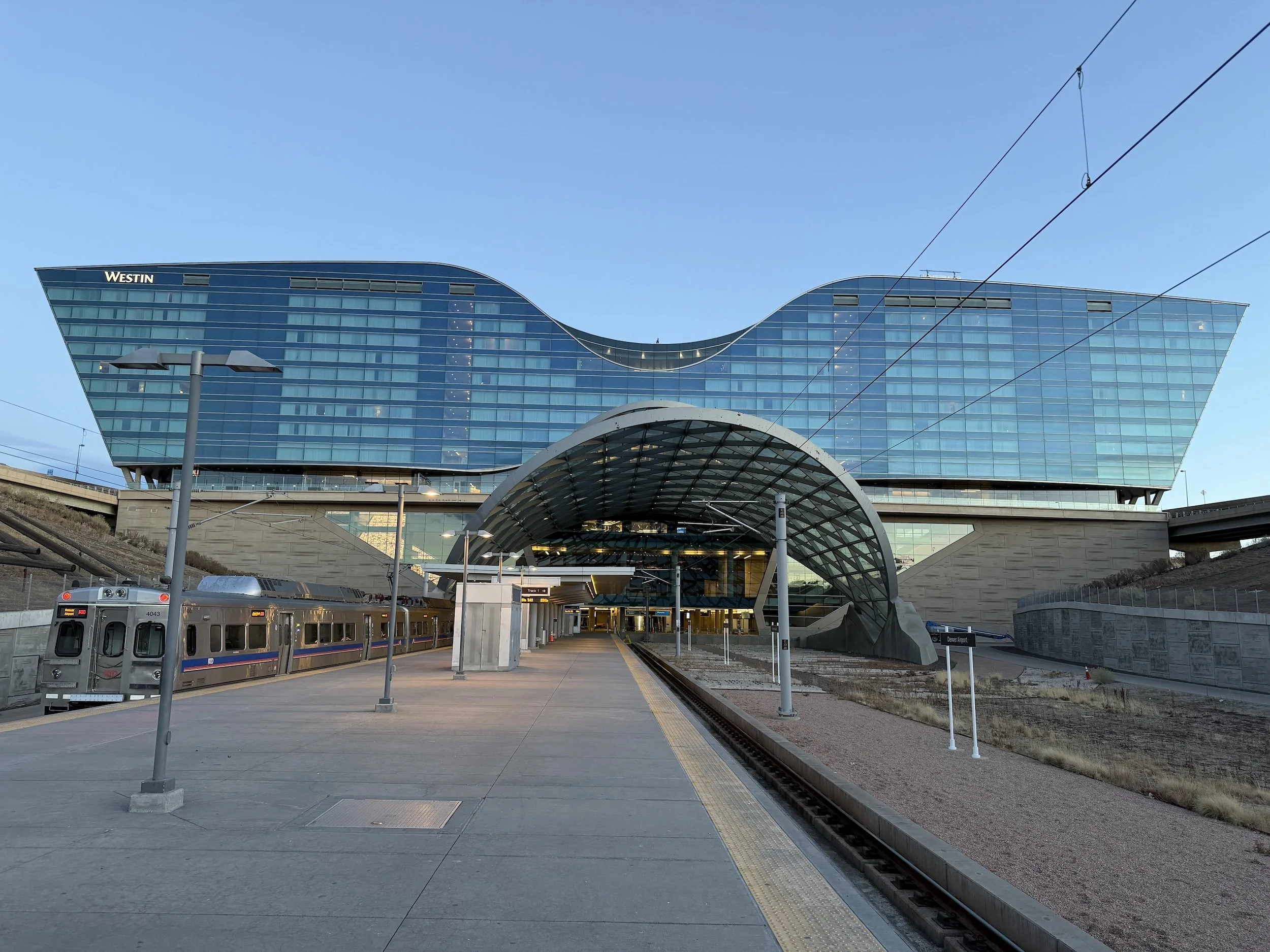
In the end, by turning itself into a living work of public art, Denver International Airport invites interpretation like that and leaves itself open to any number of off-the-wall theories. You could read serious meaning into it, and it certainly is tempting to see what psychologist Carl Jung would call “synchronicity” in its many little coincidences. Yet the deeper down the rabbit hole you go with DIA-related conspiracy theories, the more they start to sound like the kind of crackpot ideas that might originate from a dorm room late at night. This is what happens when people spend too much time online, after partaking of the sacrament, perhaps, at Denver’s International Church of Cannabis.
Unlike Blucifer, the church employs real laser lights in its amazing technicolor dream show. For those more interested in pop culture connections than wacky tobacky, the Denver area also holds other interesting landmarks, such as the Red Rocks Park and Amphitheater, where U2 recorded the live album Under a Blood Red Sky and the music video for “Sunday Bloody Sunday” back in the 1980s.
Having flown into Denver more than once now, I can’t discount the possibility that its airport is a magnet for dark energy or a front for government secrets. But as much as it engages the creative part of my brain, I remain agnostic about whether there’s really anything more than meets the eye at Denver International Airport.